At a glance
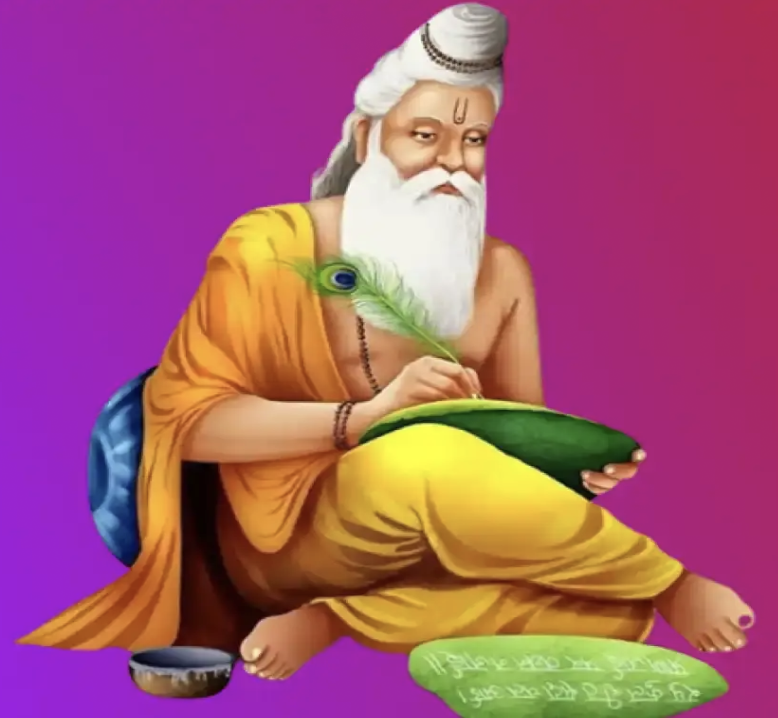
- Name & meaning: Valmiki (वाल्मीकि), from valmika, an anthill: “the one who came out of the anthill”.
- Other names: Adi Kavi (the first poet), Prachetasa (son of Prachetas); among devotees in north India also Bhagwan Valmiki, Balmiki, Lal Beg and Bala Shah.
- Category: Maharshi; revered as a Brahmarshi and as the first poet of classical Sanskrit.
- Father: Prachetas: in the Uttara Kanda of the Ramayana Valmiki calls himself Prachetas’s tenth son. Later tradition identifies Prachetas with Varuna.
- Mother: Not named in the Valmiki Ramayana; later sources differ.
- Spouse: None named in the Ramayana. Only the later robber legends give him a wife and family.
- Disciples: Bharadvaja (who walks with him to the Tamasa river in the Bala Kanda), and Lava and Kusha, the twin sons of Rama and Sita, his first reciters.
- Era: Traditionally Treta Yuga, a contemporary of Rama. Scholars place the earliest layer of the Ramayana somewhere between roughly the 8th and 4th centuries BCE, with later layers into the early centuries CE.
- Ashram: On the Tamasa river not far from the Ganga (Bala Kanda); Rama also visits him at Chitrakuta (Ayodhya Kanda). Places that claim his ashram today include Ram Tirath near Amritsar and Valmiki Ashram in Chitwan, Nepal.
- Major works: The Ramayana (about 24,000 shlokas in seven kandas). The Yoga Vasishtha is traditionally attributed to him, but scholars date it far later.
- Best known for: The “ma nishada” shloka, composing the Ramayana, and sheltering Sita and raising Lava and Kusha.
Birth and family background
The Ramayana itself says remarkably little about its author’s early life. In the Uttara Kanda, when Valmiki brings Sita before Rama’s assembly, he vouches for her by swearing on his own truthfulness and introduces himself as the tenth son of Prachetas. That is why he is also called Prachetasa. Puranic tradition treats Prachetas as a name of Varuna, the god of the waters, and so some accounts call Valmiki a son of Varuna.
His name is explained by a different story. He is said to have sat in meditation so long and so still that ants built a hill (valmika) over him, and he “came out of the anthill” reborn as a sage. Where he was before that is where the accounts split, and they are covered in the section on variant traditions below.
Life and key episodes
Narada’s question and the story of Rama
The Valmiki Ramayana opens with Valmiki asking the sage Narada a simple question: is there anyone alive today who is truly virtuous, truthful, steady in his vows, kind to all beings and free of envy? Narada’s answer is a short account of Rama’s life. The first sarga of the Bala Kanda is this conversation, and it serves as a summary of the whole epic.
The krauncha birds and the first shloka
The second sarga tells the scene everyone remembers. After Narada leaves, Valmiki goes to bathe in the Tamasa river with his disciple Bharadvaja. He is watching a pair of krauncha birds when a hunter shoots the male, and the female cries out over her dead mate. Moved by grief and anger, Valmiki speaks words that come out in a new, perfectly measured metre:
मा निषाद प्रतिष्ठां त्वमगमः शाश्वतीः समाः ।
यत् क्रौञ्चमिथुनादेकमवधीः काममोहितम् ॥ (Bala Kanda 1.2.15)
“O hunter, may you find no rest for endless years, for you killed one of this pair of krauncha birds while it was lost in love.” Valmiki is puzzled by what he has said. Then Brahma appears and tells him that the verse came from Saraswati by his will, and that in this same metre he should tell the whole story of Rama. Valmiki himself names the new form (1.2.18): since it came from a man stricken with grief (shoka), let it be called a shloka. The first poem of Sanskrit grew out of compassion for a bird.
Host to Rama, refuge for Sita
In the Ayodhya Kanda, Rama, Sita and Lakshmana reach Chitrakuta at the start of their exile, visit Valmiki’s hermitage and are welcomed by him before building their hut nearby. Much later, in the Uttara Kanda, Rama sends Sita away. She finds shelter in Valmiki’s ashram and gives birth there to the twins Lava and Kusha. Valmiki raises them, and as the Bala Kanda’s fourth sarga describes, teaches them the whole poem. The boys sing it before the sages and finally before Rama himself at his Ashvamedha sacrifice, without knowing that he is their father. Valmiki then brings Sita to the assembly and vouches for her purity, and she asks the Earth to take her back.
In the Mahabharata
Valmiki appears briefly in the Mahabharata too. In the Anushasana Parva he is among the sages who visit Yudhishthira after the war, and he tells how he was once accused of the sin of killing a brahmin and was freed of it by worshipping Shiva.
Achievements and contributions
- The first kavya: Indian tradition calls the Ramayana the adi-kavya, the first poem of classical Sanskrit, and Valmiki the adi-kavi. Kalidasa, Bhavabhuti and almost every later Sanskrit poet treat him as the founder of their craft.
- The shloka metre: The anushtubh-based shloka he used became the standard metre of Sanskrit epic and Puranic verse.
- The shape of Rama’s story: Nearly every later Ramayana, including Kamban’s Tamil, Krittivas’s Bengali and Tulsidas’s Awadhi Ramcharitmanas, either retells Valmiki’s poem or answers it.
- A teacher who took in the abandoned: Many readers remember most his care for Sita and her sons when the royal court had turned them out.
Writings attributed to him
The Ramayana is the work that carries his name. The text is about 24,000 shlokas in seven kandas: Bala, Ayodhya, Aranya, Kishkindha, Sundara (read separately as the Sundarkand), Yuddha and Uttara. It is unusual in that its author also appears in the story. Scholars generally think the poem grew over centuries. The Bala and Uttara Kandas are often seen as later additions, and translators Robert and Sally Goldman note that much of the Uttara Kanda is told through other characters rather than directly by Valmiki.
The Yoga Vasishtha, a long philosophical dialogue between Vasishtha and the young Rama, is traditionally ascribed to Valmiki. Modern scholarship dates it to around the 10th to 14th centuries CE, and its real author is unknown. The Valmiki Samhita, a work of Rama worship, also circulates under his name as a traditional attribution.
Why he is revered today
- Valmiki Jayanti (also called Pargat Diwas) falls on the full moon of Ashvin, around October. Temples hold processions and Ramayana recitations.
- For the Balmiki community of north India, he is Bhagwan Valmiki, their patron saint and guru, with many mandirs dedicated to him. The Bhagwan Valmiki Tirath Sthal at Ram Tirath near Amritsar is revered as the site of his ashram and the birthplace of Lava and Kusha.
- In Tamil Nadu, the Siddha tradition honours him as Vanmeegar, one of the eighteen Siddhars. Tiruvanmiyur in Chennai is believed to take its name from him and has an old temple to him.
- Every Rama temple, every Ramlila before Dussehra, and every Sundarkand path goes back ultimately to the story he first told.
Variant traditions and a historical note
The robber story is not in the Valmiki Ramayana. The well-known tale of a highway robber (called Ratnakar in popular retellings) who meets the Saptarishis, is sent home to ask whether his family will share his sins, learns that they will not, and then chants “mara, mara” until it becomes “Rama” while an anthill grows over him, comes from later sources. A version appears in the Adhyatma Ramayana, a text scholars date to roughly the 13th to 15th centuries. The Nagara Khanda of the Skanda Purana tells a different version, in which he is a devoted brahmin named Lohajangha who turns to robbery to feed his family during a twelve-year drought, and whom the sage Pulaha gives a mantra. Tulsidas refers to the tradition in the Ayodhya Kand of the Ramcharitmanas: “उलटा नामु जपत जगु जाना। बालमीकि भए ब्रह्म समाना॥”, meaning the world knows that by chanting the name backwards Valmiki became like Brahman.
The story matters to many people as a parable of how japa and the Name can change anyone. It is also sensitive. Many in the Balmiki community reject the “dacoit” label as a later slur on their guru. A researcher who held the Maharishi Valmiki Chair at Punjabi University argued that no early text portrays him as a bandit, and describing him as one has led to police complaints and court cases. The fairest thing to say is that the Ramayana itself presents Valmiki only as a great sage and the son of Prachetas, and that the robber story is a later devotional tradition.
On dating: tradition places Valmiki in the Treta Yuga. Scholars cannot date him, since nothing survives about him outside the poem and the legends, and they date the Ramayana text in layers, as noted above. The Vishnudharmottara Purana calls him a form of Brahma, and a popular belief holds that he was reborn as Tulsidas.
Frequently asked questions
Was Valmiki really a dacoit?
Not according to the Valmiki Ramayana, which never says so. The robber story comes from later texts such as the Adhyatma Ramayana and the Skanda Purana, and from popular retellings, and the Balmiki community disputes it.
What was the first shloka?
“Ma nishada pratishtham…” (Bala Kanda 1.2.15), spoken when a hunter killed one of a pair of krauncha birds. It is traditionally called the first shloka of Sanskrit poetry.
When is Valmiki Jayanti?
On Ashvin Purnima, the full moon of the month of Ashvin, which usually falls in October.
Did Valmiki and Tulsidas write the same Ramayana?
No. Valmiki’s Ramayana is the Sanskrit epic. Tulsidas’s Ramcharitmanas, written in Awadhi in the 16th century, is a devotional retelling that draws on Valmiki and on later texts such as the Adhyatma Ramayana.