Original text
अम्बे तू है जगदम्बे काली, जय दुर्गे खप्पर वाली । तेरे ही गुण गाये भारती, ओ मैया हम सब उतरें, तेरी आरती ॥ तेरे भक्त जनो पर, भीर पडी है भारी माँ । दानव दल पर टूट पडो, माँ करके सिंह सवारी । सौ-सौ सिंहो से बलशाली, अष्ट भुजाओ वाली, दुष्टो को पल में संहारती । ओ मैया हम सब उतरें, तेरी आरती ॥ अम्बे तू है जगदम्बे काली, जय दुर्गे खप्पर वाली । तेरे ही गुण गाये भारती, ओ मैया हम सब उतरें, तेरी आरती ॥ माँ बेटे का है इस जग में, बडा ही निर्मल नाता । पूत - कपूत सुने है पर न, माता सुनी कुमाता ॥ सब पे करूणा दरसाने वाली, अमृत बरसाने वाली, दुखियो के दुखडे निवारती । ओ मैया हम सब उतरें, तेरी आरती ॥ अम्बे तू है जगदम्बे काली, जय दुर्गे खप्पर वाली । तेरे ही गुण गाये भारती, ओ मैया हम सब उतरें, तेरी आरती ॥ नही मांगते धन और दौलत, न चांदी न सोना माँ । हम तो मांगे माँ तेरे मन में, इक छोटा सा कोना ॥ सबकी बिगडी बनाने वाली, लाज बचाने वाली, सतियो के सत को सँवारती । ओ मैया हम सब उतरें, तेरी आरती ॥ अम्बे तू है जगदम्बे काली, जय दुर्गे खप्पर वाली । तेरे ही गुण गाये भारती, ओ मैया हम सब उतरें, तेरी आरती ॥ चरण शरण में खडे तुम्हारी, ले पूजा की थाली । वरद हस्त सर पर रख दो, माँ संकट हरने वाली । माँ भर दो भक्ति रस प्याली, अष्ट भुजाओ वाली, भक्तो के कारज तू ही सारती । ओ मैया हम सब उतरें, तेरी आरती ॥ अम्बे तू है जगदम्बे काली, जय दुर्गे खप्पर वाली । तेरे ही गुण गाये भारती, ओ मैया हम सब उतरें, तेरी आरती ॥
Transliteration
Ambe tu hai Jagdambe Kali, Jai Durge khappar wali. Tere hi gun gaaye Bharati, O maiya hum sab utaren, teri aarti. Tere bhakt jano par, bheer padi hai bhaari maa. Daanav dal par toot pado, maa karke singh sawaari. Sau-sau singho se balshaali, asht bhujaon waali, dushton ko pal mein sanhaarti. O maiya hum sab utaren, teri aarti. (Refrain) Maa bete ka hai is jag mein, bada hi nirmal naata. Poot-kapoot sune hai par na, maata suni kumaata. Sab pe karuna darsaane waali, amrit barsaane waali, dukhiyon ke dukhde nivaarti. O maiya hum sab utaren, teri aarti. (Refrain) Nahi maangte dhan aur daulat, na chaandi na sona maa. Hum to maange maa tere man mein, ik chhota sa kona. Sabki bigdi banaane waali, laaj bachaane waali, satiyon ke sat ko sanvaarti. O maiya hum sab utaren, teri aarti. (Refrain) Charan sharan mein khade tumhaari, le pooja ki thaali. Varad hast sar par rakh do, maa sankat harne waali. Maa bhar do bhakti ras pyaali, asht bhujaon waali, bhakton ke kaaraj tu hi saarti. O maiya hum sab utaren, teri aarti. (Refrain)
Durga and Kali in one breath
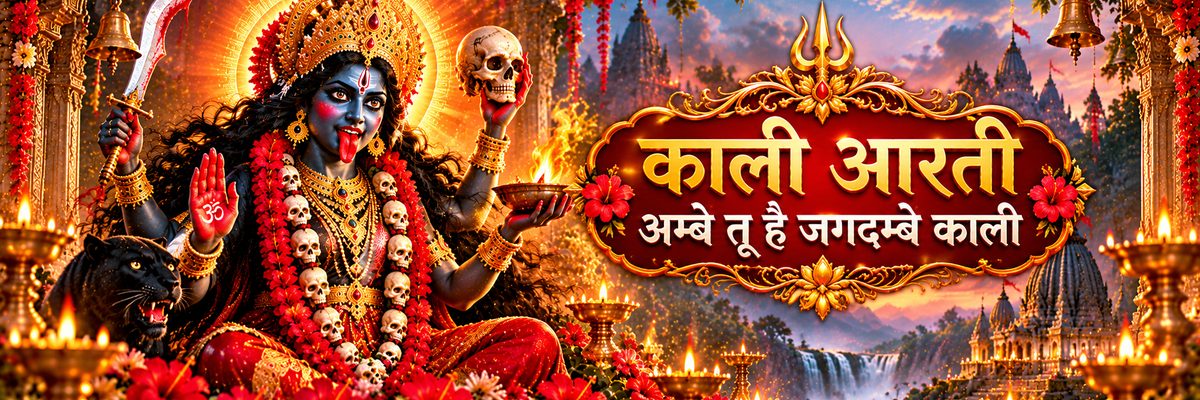
The refrain names the Mother twice over: Ambe tu hai Jagdambe Kali, "you are Amba, the world-mother, Kali", and Jai Durge khappar wali, "victory to Durga who holds the skull-bowl". The khappar, the bowl Kali carries to catch Raktabija's blood, is her emblem. So in a single couplet the aarti says what the Devi Mahatmya teaches: the lion-riding, eight-armed Durga and the fierce Kali are one Mother. That is why it is sung for both, and why it sits naturally on Kali's page here. It is a popular modern devotional aarti, made famous by recordings sung at mata ki chowkis and jagrans, rather than an old temple text, and its author is not recorded.
What the stanzas ask
- Come and fight (1): "A heavy crowd of troubles has fallen on your devotees, Mother. Ride your lion and fall upon the demon army." She is stronger than hundreds of lions, eight-armed, and destroys the wicked in an instant.
- A mother cannot be unkind (2): the most quoted lines. "Of mother and child, the bond in this world is the purest. We have heard of a bad son, but never of a bad mother." Whatever the devotee has done, the Mother still pours compassion and nectar on all.
- Not gold, only a corner (3): "We do not ask for wealth or riches, neither silver nor gold. We ask only a small corner in your heart." She mends what has gone wrong, saves our honour, and upholds the virtue of the faithful.
- Bless us (4): "We stand at the refuge of your feet with the puja thali. Place your boon-giving hand on our heads, remover of troubles; fill our cup with the nectar of devotion."
When to sing it
It is sung on Fridays, through both Navratris, on Ashtami, and at mata ki chowkis and night-long jagrans. On Kali Puja night and on the seventh night of Navratri it makes a fitting close after the Kali Chalisa and the Kalikashtakam. Wave the ghee or camphor lamp before the Mother through the whole aarti, ring the bell, and offer the flame to everyone at the end.
Spotted a mistake?
If you find any grammatical, Hindi, English, mantra-text or other mistake on this page, tell us — we will correct it within 24 hours.