
Original text
अस्य श्रीशीतलास्तोत्रस्य महादेव ऋषिः । अनुष्टुप् छन्दः । शीतला देवता । लक्ष्मीर्बीजम् । भवानी शक्तिः । सर्वविस्फोटकनिवृत्यर्थे जपे विनियोगः ॥ ईश्वर उवाच । वन्देऽहं शीतलां देवीं रासभस्थां दिगम्बराम् । मार्जनीकलशोपेतां शूर्पालङ्कृतमस्तकाम् ॥१॥ वन्देऽहं शीतलां देवीं सर्वरोगभयापहाम्। यामासाद्य निवर्तेत विस्फोटकभयं महत् ॥२॥ शीतले शीतले चेति यो ब्रूयाद्दाहपीडितः । विस्फोटकभयं घोरं क्षिप्रं तस्य प्रणश्यति ॥३॥ यस्त्वामुदकमध्ये तु ध्यात्वा सम्पूजयेन्नरः । विस्फोटकभयं घोरं गृहे तस्य न जायते ॥४॥ शीतले ज्वरदग्धस्य पूतिगन्धयुतस्य च । प्रणष्टचक्षुषः पुंसस्त्वामाहुर्जीवनौषधम् ॥५॥ शीतले तनुजान् रोगान् नृणां हरसि दुस्त्यजान् । विस्फोटकविदीर्णानां त्वमेकाऽमृतवर्षिणी ॥६॥ गलगण्डग्रहा रोगा ये चान्ये दारुणा नृणाम् । त्वदनुध्यानमात्रेण शीतले यान्ति सङ्क्षयम् ॥७॥ न मन्त्रो नौषधं तस्य पापरोगस्य विद्यते । त्वामेकां शीतले धात्रीं नान्यां पश्यामि देवताम् ॥८॥ मृणालतन्तुसदृशीं नाभिहृन्मध्यसंस्थिताम् । यस्त्वां सञ्चिन्तयेद्देवि तस्य मृत्युर्न जायते ॥९॥ अष्टकं शीतलादेव्या यो नरः प्रपठेत्सदा । विस्फोटकभयं घोरं गृहे तस्य न जायते ॥१०॥ श्रोतव्यं पठितव्यं च श्रद्धाभक्तिसमन्वितैः । उपसर्गविनाशाय परं स्वस्त्ययनं महत् ॥११॥ शीतले त्वं जगन्माता शीतले त्वं जगत्पिता । शीतले त्वं जगद्धात्री शीतलायै नमो नमः ॥१२॥ रासभो गर्दभश्चैव खरो वैशाखनन्दनः । शीतलावाहनश्चैव दूर्वाकन्दनिकृन्तनः ॥१३॥ एतानि खरनामानि शीतलाग्रे तु यः पठेत् । तस्य गेहे शिशूनां च शीतलारुङ् न जायते ॥१४॥ शीतलाष्टकमेवेदं न देयं यस्यकस्यचित् । दातव्यं च सदा तस्मै श्रद्धाभक्तियुताय वै ॥१५॥ ॥ इति श्रीस्कन्दपुराणे शीतलाष्टकं सम्पूर्णम् ॥
Transliteration
Asya shrishitalastotrasya mahadeva rishih Anushtup chhandah shitala devata Lakshmirbijam bhavani shaktih Sarvavisphotakanivrityarthe jape viniyogah || Ishvara uvacha Vande'ham shitalam devim rasabhastham digambaram Marjanikalashopetam shurpalankritamastakam ||1|| Vande'ham shitalam devim sarvarogabhayapaham Yamasadya nivarteta visphotakabhayam mahat ||2|| Shitale shitale cheti yo bruyaddahapiditah Visphotakabhayam ghoram kshipram tasya pranashyati ||3|| Yastvamudakamadhye tu dhyatva sampujayennarah Visphotakabhayam ghoram grihe tasya na jayate ||4|| Shitale jvaradagdhasya putigandhayutasya cha Pranashtachakshushah punsastvamahurjivanaushadham ||5|| Shitale tanujan rogan nrinam harasi dustyajan Visphotakavidirnanam tvameka'mritavarshini ||6|| Galagandagraha roga ye chanye daruna nrinam Tvadanudhyanamatrena shitale yanti sankshayam ||7|| Na mantro naushadham tasya paparogasya vidyate Tvamekam shitale dhatrim nanyam pashyami devatam ||8|| Mrinalatantusadrishim nabhihrinmadhyasansthitam Yastvam sanchintayeddevi tasya mrityurna jayate ||9|| Ashtakam shitaladevya yo narah prapathetsada Visphotakabhayam ghoram grihe tasya na jayate ||10|| Shrotavyam pathitavyam cha shraddhabhaktisamanvitaih Upasargavinashaya param svastyayanam mahat ||11|| Shitale tvam jaganmata shitale tvam jagatpita Shitale tvam jagaddhatri shitalayai namo namah ||12|| Rasabho gardabhashchaiva kharo vaishakhanandanah Shitalavahanashchaiva durvakandanikrintanah ||13|| Etani kharanamani shitalagre tu yah pathet Tasya gehe shishunam cha shitalarun na jayate ||14|| Shitalashtakamevedam na deyam yasyakasyachit Datavyam cha sada tasmai shraddhabhaktiyutaya vai ||15|| || iti shriskandapurane shitalashtakam sampurnam ||
Shiva's hymn to the cooling goddess
The Sheetalashtakam is presented as spoken by Ishvara (Shiva), and its colophon places it in the Skanda Purana. Before the verses comes a short viniyoga — the formal statement of a mantra's seer, metre, deity and purpose: the seer is Mahadeva, the metre anushtubh, the deity Sheetala, the seed Lakshmi, the power Bhavani, and the purpose "the removal of all eruptive diseases" (sarva-visphotaka-nivritti). That purpose runs through every verse.
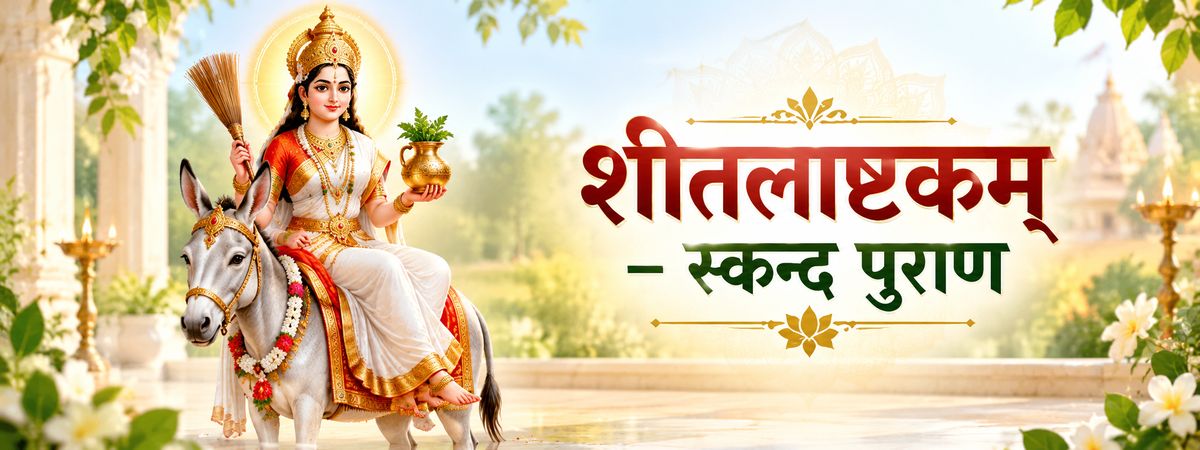
The first verse gives the image found in her shrines across north India: "I bow to Goddess Sheetala, seated on a donkey, sky-clad, holding a broom and a water pot, her head adorned with a winnowing fan." Broom, water and winnowing fan are tools for cleaning, cooling and separating the bad from the good.
What the verses say
- Verses 2–4: she removes the fear of every disease; whoever, burning with fever, simply calls "Sheetale, Sheetale" is quickly freed from the dread of pox; and in the house of one who worships her standing in water, that fear never arises.
- Verses 5–7: for one burnt by fever, giving off a foul smell and losing sight, she is called the medicine of life; she alone rains nectar on those torn by eruptions; goitre and other cruel diseases vanish at the mere thought of her.
- Verse 8: for that "disease of sin" there is no mantra and no medicine — "I see no deity but you, O Sheetala, the sustainer."
- Verse 9: a meditation verse: whoever contemplates her as fine as a lotus-fibre, dwelling between navel and heart, does not meet death.
- Verses 10–12 (phala-shruti): reading this ashtaka keeps pox from the house; it should be heard and read with faith as a great blessing against all affliction; "you are the world's mother, father and sustainer — salutations to Sheetala."
- Verses 13–15: six names of her donkey — Rasabha, Gardabha, Khara, Vaishakhanandana, Sheetala-vahana and Durva-kanda-nikrintana ("cutter of durva roots"). Whoever recites these before Sheetala, it says, keeps her illness away from the children of the house. The hymn ends by saying it should be given only to those with faith.
How it is used
- On Sheetala Ashtami (Basoda), Chaitra Krishna Ashtami, after the cold-food offering, and alongside the Hindi Sheetala Mata aarti and Sheetala Chalisa.
- When a child has fever, chickenpox or measles — traditionally recited in the house, with water sprinkled with neem leaves, alongside proper medical care.
- Many recite the root mantra Om hrim shrim Sheetalayai namah eleven times before the stotra, as some printed editions direct.
Frequently asked questions
Who composed the Sheetala Ashtakam?
The text presents itself as spoken by Ishvara (Shiva), and its closing line places it in the Skanda Purana. It is traditional, not attributed to a later poet.
Why is it called an "ashtakam" if it has fifteen verses?
The core hymn of praise is eight verses (2–9 after the opening dhyana); the rest are the phala-shruti and the closing verses on the donkey's names, as is common in Puranic stotras.
Why does Sheetala ride a donkey?
The donkey is her vahana; the hymn even lists its names. Folk explanation links it to patience and humble service, and to the washerman's donkey that carried cloth — and with it, contagion — from house to house.
Can the Sheetala Ashtakam be recited for children's health?
Yes, that is its most common use today. It is a prayer, not a substitute for treatment: tradition and medicine go together.
When should it be recited?
On Sheetala Saptami or Ashtami, on any Ashtami, during illness in the house, and in Chaitra and Vaishakh, when her worship is most widespread.
Spotted a mistake?
If you find any grammatical, Hindi, English, mantra-text or other mistake on this page, tell us — we will correct it within 24 hours.