
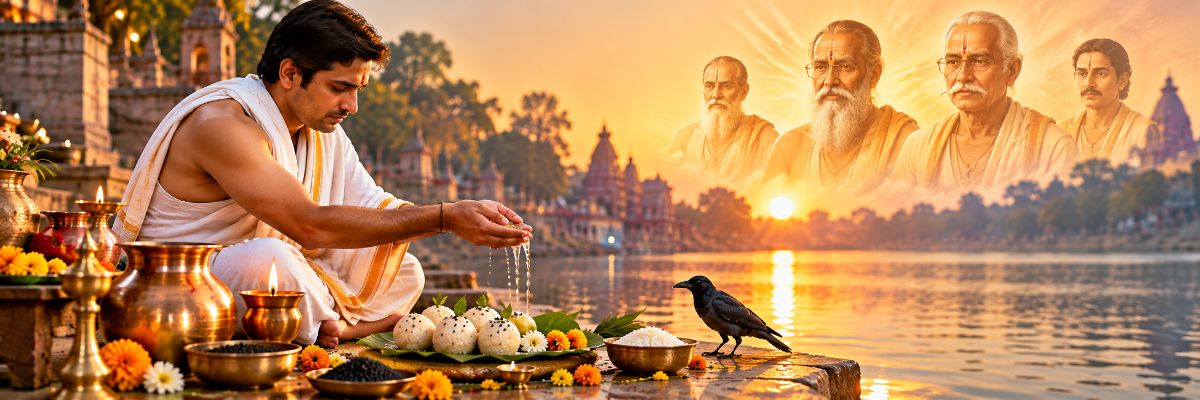
What Pitru Paksha is
Pitru Paksha, "the fortnight of the ancestors", is a period of about sixteen lunar days each year set aside for remembering and feeding one's forebears. It is also called Shraddha Paksha, Mahalaya Paksha, and in parts of North India Kanagat. It begins after the full moon of Bhadrapada and runs through the waning fortnight to the new moon, which usually places it in September or early October. In the purnimanta calendar followed across most of North India this waning fortnight belongs to Ashwin; in the amanta calendar of the south and west it is counted as part of Bhadrapada. It is the same fortnight either way, only named differently. It ends on Sarva Pitru Amavasya, also called Mahalaya Amavasya, and the very next day Sharad Navratri begins.
Why ancestors are remembered at all
The idea rests on a sense of debt. The scriptures speak of three debts every person is born with: to the gods (deva rin), to the sages who handed down knowledge (rishi rin), and to the ancestors who gave one life and family (pitru rin). The last is repaid by continuing the family, by living well, and by shraddha, a word that comes from shraddha in the sense of faith: what is offered with faith. Traditionally the offering reaches the three preceding generations on the father's side (father, grandfather and great-grandfather), and many families include the mother's side as well.
A well-known story explains why the fortnight matters. When the warrior Karna reached heaven after the Mahabharata war, he was served gold and jewels instead of food. He had given away great wealth in his life, he was told, but had never offered food to his ancestors. He was allowed to return to earth for sixteen days to do so, and those days became Pitru Paksha. The story is a popular one rather than part of the Mahabharata text itself, but it captures the spirit of the period: what the ancestors need is food and remembrance, given sincerely.
Choosing the day: the tithi of death
Shraddha for a particular person is performed on the lunar day (tithi) of the fortnight that matches the tithi on which they died, not the calendar date. Someone who died on a Panchami is remembered on the Panchami of Pitru Paksha, whatever month it was. A few days carry special meaning:
- Navami, often called Matri Navami or Avidhava Navami, is kept for mothers and for women who died while their husbands were living.
- Chaturdashi is traditionally reserved for those who died unnaturally, through accident, violence or weapons.
- Sarva Pitru Amavasya, the last day, is for everyone: ancestors whose tithi is not known, and anyone who could not be remembered on their own day.
What is actually done
The rites vary by family and region, but the main elements are the same almost everywhere:
- Tarpan: offering water mixed with black sesame seeds, held in the hand with kusha grass, while facing south, the direction associated with the ancestors. The sacred thread is worn over the right shoulder for this rite (apasavya), the reverse of its usual position.
- Pinda daan: offering balls of cooked rice, often mixed with sesame, ghee and honey, which stand for the body and nourishment of the departed.
- Feeding: a simple sattvic meal is cooked, and portions are set aside for a cow, a dog, crows and ants before brahmins or guests are fed. Crows in particular are thought to carry the offering to the ancestors, and families watch for them to come to the food.
- Charity: giving food, clothes or money to those in need in the ancestors' names.
Many families perform these at home with a priest; others go to a river or a pilgrimage centre. Gaya in Bihar, with the Vishnupad temple and the Phalgu river, is the most famous place for pinda daan, and a shraddha done there is traditionally held to be especially complete.
What families usually avoid
Because the fortnight is devoted to the departed, it is generally not used for new beginnings. Many families avoid weddings, engagements, housewarmings, starting a business, and buying new clothes, jewellery or vehicles until it is over. Some also avoid onion, garlic and non-vegetarian food, and some men do not cut their hair or shave. These customs differ widely, and none of them is the heart of the matter; the core of Pitru Paksha is the offering itself and the remembering.
A way to keep the observance simple
If you have never done shraddha and do not have a family priest, a simple observance is still meaningful. On your ancestor's tithi, or on Sarva Pitru Amavasya, bathe, sit facing south, offer water with a few black sesame seeds while saying their names, set aside a portion of a simple meal for a cow, crows or a hungry person, and spend a moment remembering who they were. Many people also read a chapter of the Bhagavad Gita, traditionally the second, which speaks of the soul that is never born and never dies. If you keep a daily prayer routine, the fortnight is a natural time to add your ancestors to it.