
Where the stories come from
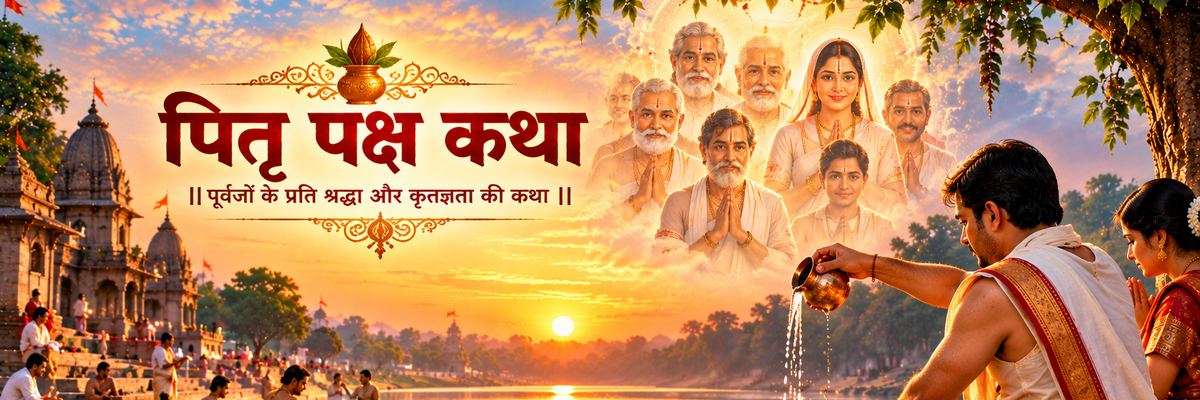
Two stories are told about the shraddha offered to ancestors in Pitru Paksha. The first comes from the Mahabharata itself, in the Anushasana Parva (sections 91 and 92), where Bhishma answers Yudhishthira's question: "By whom was the Sraddha first conceived, and at what time?" It tells of the sage Nimi, who performed the first shraddha. The second, the story of Karna, is a popular tradition told to explain why the fortnight exists. It is not found in the Mahabharata text, and is told here as tradition.
Nimi and the first shraddha
Bhishma begins with a lineage. From Brahma was born the sage Atri, and in Atri's line was born Dattatreya. Dattatreya's son was the ascetic Nimi, and Nimi had a son named Shrimat, known for his great beauty. After a full thousand years of the severest austerities, Shrimat died, "succumbing to the influence of Time".
Nimi performed the purifying rites of mourning, but grief would not leave him, and he thought continually of his son. On the fourteenth day of the moon he gathered the foods his son had liked. The next morning, still heavy with sorrow, he found his mind could turn from its grief to something else, and "with concentrated attention he then conceived the idea of a Sraddha".
On the new-moon day (Amavasya) he invited Brahmins to his hermitage, seated them on seats of kusha grass and walked around them in reverence. To seven of them he served syamaka rice cooked without salt. Before them he laid blades of kusha with their tips pointing south, and with a pure body and a focused mind he offered cakes of rice (pinda) to his dead son, speaking his name and family.
Then fear came over him. He had done something no scripture he knew of had laid down. "Never done before by the Munis, alas, what have I done!" he thought, afraid he would be cursed for inventing a strange rite. He thought of the founder of his line, and the sage Atri appeared. Seeing how Nimi grieved for his son, Atri comforted him: the rite he had conceived was a sacrifice in honour of the Pitris, the ancestors, and it had not been invented by him at all. "Let no fear be thine," Atri said. "The Grandsire Brahman himself, in days of old, laid it down." Atri then taught him the proper order of the rite: offerings first into the sacred fire, to Agni, Soma and Varuna; a share for the Vishvedevas, the constant companions of the Pitris; and praise for the Earth, who holds the offerings.
Why Agni takes the first share
The next section tells what followed. After Nimi, all the great sages began to perform shraddha, and people everywhere made offerings to the Pitris. The ancestors, and the gods with them, were soon so overfed that they could not digest it all. They went to Soma for help, and Soma sent them to Brahma. Brahma pointed to Agni, the god of fire, sitting beside him, and Agni said: "When a Sraddha comes, we shall together eat the offerings made to us." Eating with Agni, the Pitris digested their offerings with ease. "It is for this reason," Bhishma says, "that in making offerings at Sraddhas a share is first offered to the deity of fire." Bhishma adds that offering a share to Agni first also protects the shraddha from harm, and that the three pindas are offered in order to the father, the grandfather and the great-grandfather.
Karna and the fortnight of the ancestors (a popular tradition)
A story told across North India explains why the fortnight itself is kept. When Karna died in the Kurukshetra war and reached heaven, he was hungry, but everything he was given to eat was gold. Karna had been famous as the most generous of givers, and had given away gold all his life. He asked why he was being fed gold, and was told that in all his giving he had never offered food and water to his ancestors in shraddha. Karna answered that he had not known who his ancestors were: he had been raised by a charioteer's family, and learned only on the eve of the war that Kunti was his mother. He was allowed to return to earth for a fortnight to offer food and water in their memory, and that fortnight became Pitru Paksha.
What the stories teach
Nimi's story puts grief at the very root of shraddha: the first offering to the ancestors was a father feeding the son he could not stop thinking about. Atri's answer turns that private grief into a duty that belongs to everyone, and gives it an order. Karna's story makes the point in a different way: even the most generous life is incomplete if the people who came before us are forgotten, and what they ask for is not gold but food, water and remembrance. For how shraddha is performed today, the tithis of Pitru Paksha and the rules for tarpan, see Pitru Paksha: meaning, rituals and shraddha.