
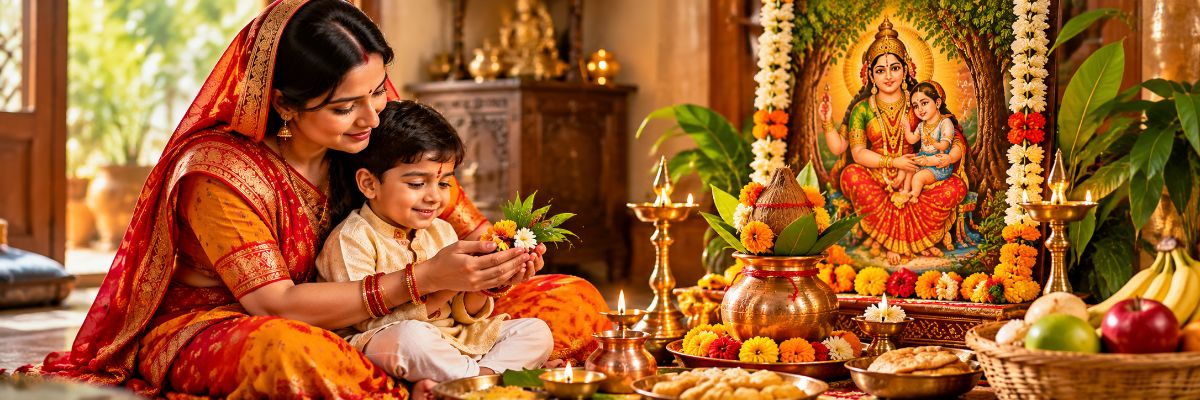
Jivitputrika Vrat 2026: the decision at a glance
- Fast (pure Ashtami): Saturday, 3 October 2026
- Nahay-Khay: Friday, 2 October 2026
- Parana, breaking the fast (Navami): Sunday, 4 October 2026, after Ashtami ends at 05:51 AM
- Why: this year the Saptami tithi lasts less than twelve dandas, so on Saturday the Ashtami is not viddha (touched) by Saptami. It is a pure Ashtami that falls within the time of worship, and the parana can be done in Navami the next day.
This decision is by Jyotishacharya Harendra Chaubey. Drik Panchang also gives Saturday 3 October for the fast; if your family follows a different local custom, confirm with your family priest.
Panchang details for 2026
The times below are from Drik Panchang. Tithi times are the same across India; sunrise differs by city.
| Patna | Varanasi | |
|---|---|---|
| Ashtami begins | 07:59 AM, Saturday 3 October | |
| Ashtami ends | 05:51 AM, Sunday 4 October | |
| Sunrise, 3 October | 05:42 AM | 05:51 AM |
| Saptami remaining after sunrise, 3 October | 2 h 17 min (about 5.7 dandas) | 2 h 8 min (about 5.3 dandas) |
| Sunset, 3 October | 05:34 PM | 05:43 PM |
| Sunrise, 4 October | 05:43 AM | 05:51 AM |
| Ashtami remaining after sunrise, 4 October | 8 min | about 0 min |
What this shows: on Saturday 3 October, Saptami lasts only about two hours after sunrise, well under twelve dandas (4 hours 48 minutes), and Ashtami then covers the whole afternoon, the time of worship. On Sunday 4 October, Ashtami is present at sunrise for only a few minutes, and the afternoon falls in Navami. Some calendars that go strictly by the tithi at sunrise (udaya tithi) therefore mention 4 October; the reasoning below explains why the tradition decides for 3 October. Drik Panchang also gives Saturday 3 October as the date of the fast.
What Jivitputrika (Jitiya) is
Jivitputrika, also called Jitiya or Jiutiya, is a fast kept by mothers on Ashtami of the dark fortnight of Ashwin, for the long life, health and protection of their children. It is observed with great devotion above all in Bihar, Jharkhand, eastern Uttar Pradesh and the Mithila region of Nepal. Traditionally it spans three days: Nahay-Khay on Saptami, a waterless (nirjala) fast on Ashtami, and the parana on Navami. The deity worshipped is King Jimutavahana.
The story of Jimutavahana
In the story, the generous King Jimutavahana offered himself to Garuda in place of the young Nagas who were being sent to Garuda, one by one, as his food. Moved by his sacrifice, Garuda gave up eating living beings, and sprinkled amrit (nectar) on the bones of the children he had already eaten, bringing them back to life. Mothers keep this fast in memory of that sacrifice made to protect children.
Panchang tradition and the shastras: Harendra Chaubey's reasoning
A story shapes character by portraying character. The events a story describes first took place at a particular time, and whenever that time comes round again, the story takes on added significance. When Maharaj Jimutavahana first offered his body to Garuda and had Garuda himself sprinkle amrit on the bones of the children he had eaten, bringing them back to life, it was Ashtami of the dark fortnight of Ashwin. On the following day, as well as Navami, the Ashtami that had been current at sunrise (the audayik Ashtami) also extended into the afternoon, and that was the time of worship.
In deciding the date of any fast, several things have to be weighed: a pure tithi, its presence during the time of the ritual (karmakaal vyapti), and the parana. If we look at the panchang tradition for deciding Jivitputrika, we find that whenever Saptami lasted less than twelve dandas, the decision was made on that basis. Scholars then were more given to shastrartha (learned debate) than they are today, but that debate was held only to confirm what the shastras say. Had the story's phrase "Ashtami free of Saptami" really meant that Ashtami must be current at sunrise, the panchang decision would surely have been revised long ago.
"Ashtami free of Saptami" means an Ashtami that is not viddha, not touched by Saptami. Scholars would have accepted this according to the words of the shastras, and kept the tradition of panchang decisions in line with it. Keeping these facts in view, and since the panchang shows Saptami lasting less than twelve dandas, the fast has been decided for Saturday, 3 October 2026: the Ashtami that falls within the time of worship will be free of Saptami, that is, pure, and the parana will also be possible in Navami.
The terms used in the decision
- Danda (ghati): a traditional unit of time. One danda is 24 minutes, so twelve dandas are about 4 hours 48 minutes.
- Viddha tithi: a tithi that shares its day with part of the tithi before it. A "Saptami-viddha Ashtami" is an Ashtami considered touched, and so compromised, by Saptami.
- Shuddha (aviddha) tithi: a pure tithi, not considered compromised by the one before it.
- Audayik tithi: the tithi current at sunrise.
- Karmakaal vyapti: the tithi being present during the prescribed time of the ritual. For Jivitputrika, the time of worship is the afternoon (aparahna).
- Parana: breaking the fast. Jivitputrika is broken in Navami.
How the fast is kept
By tradition, on Saptami (Nahay-Khay) women bathe and eat a simple sattvic meal. On Ashtami mothers usually keep a nirjala fast, and in the afternoon they worship Jimutavahana and listen to his story. The fast is broken on Navami. The details of the puja and the parana differ a little from family to family, so follow your own household's custom. Women who are pregnant, unwell or elderly should consult a doctor before keeping a waterless fast.