Original text
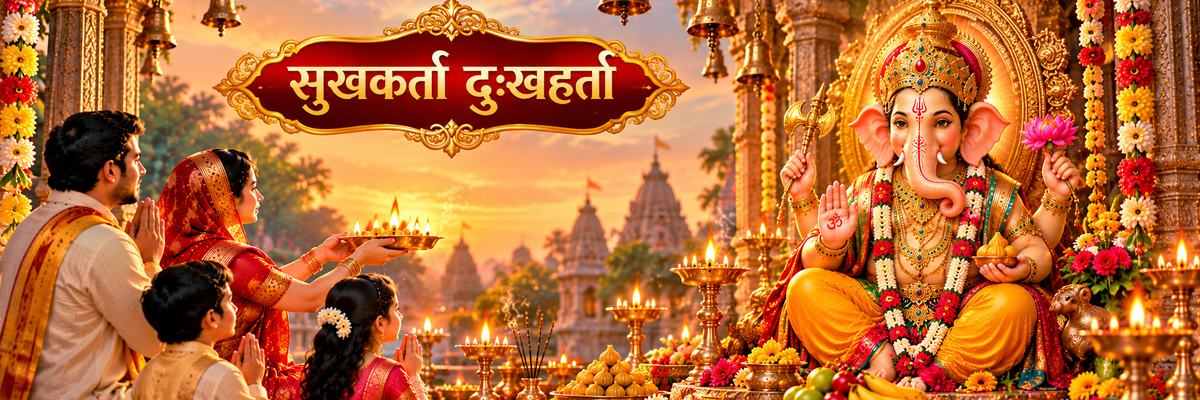
सुखकर्ता दुखहर्ता, वार्ता विघ्नांची । नुरवी पुरवी प्रेम, कृपा जयाची । सर्वांगी सुंदर, उटी शेंदुराची । कंठी झळके माळ, मुक्ताफळांची ॥१॥ जय देव, जय देव जय मंगलमूर्ती । दर्शनमात्रे मन कामना पूर्ती ॥धृ॥ रत्नखचित फरा, तुज गौरीकुमरा । चंदनाची उटी, कुमकुम केशरा । हिरेजडित मुकुट, शोभतो बरा । रुणझुणती नूपुरे, चरणी घागरिया ॥२॥ जय देव, जय देव जय मंगलमूर्ती । दर्शनमात्रे मन कामना पूर्ती ॥धृ॥ लंबोदर पीतांबर, फणिवरबंधना । सरळ सोंड, वक्रतुंड त्रिनयना । दास रामाचा, वाट पाहे सदना । संकटी पावावे, निर्वाणी रक्षावे, सुरवरवंदना ॥३॥ जय देव, जय देव जय मंगलमूर्ती । दर्शनमात्रे मन कामना पूर्ती ॥धृ॥
Transliteration
Sukhkarta Dukhharta, Varta Vighnanchi. Nuravi Puravi Prem, Kripa Jayachi. Sarvangi Sundar, Uti Shendurachi. Kanthi Jhalke Maal, Muktaphalanchi. Jai Dev, Jai Dev, Jai Mangalmurti. Darshanmatre Man Kamana Purti. (Refrain) Ratnakhachit Phara, Tuj Gaurikumara. Chandanachi Uti, Kumkum Keshara. Hirejadit Mukut, Shobhato Bara. Runjhunati Nupure, Charani Ghagariya. (Refrain) Lambodar Pitambar, Phanivarbandhana. Saral Sond, Vakratunda Trinayana. Daas Ramacha, Vaat Pahe Sadana. Sankati Pavave, Nirvani Rakshave, Survarvandana. (Refrain)
Ramdas and the Morgaon Ganesha
Sukhkarta Dukhharta is a Marathi aarti by the poet-saint Samarth Ramdas (1608–1682), and it signs itself in the last stanza: Das Ramacha, "Rama's servant", Ramdas. Tradition holds that he wrote it after seeing the Ganesha of Morgaon near Pune, Mayureshwar, the first of the eight Ashtavinayak temples. One detail supports the story: the aarti calls Ganesha trinayana, three-eyed. Most Ganesha images have two eyes, but the Morgaon idol has a third. The aarti is traditionally set in raga Jogiya, though most families sing it to the familiar household tune. A newer tune recorded by Lata and Usha Mangeshkar in 1970 is also widely loved.
What the three stanzas say
First stanza. He gives happiness and removes sorrow. The next phrase is often misheard: varta vighnanchi nuravi means "he leaves not even the talk of obstacles", and puravi prem means "he showers love", the one whose grace is everything. His whole body is beautiful, smeared with shendur (sindoor), and a necklace of pearls shines at his throat. The word is nuravi (नुरवी), often mispronounced nurvi (नुर्वी), and the two verbs are frequently run together without their meaning being noticed.
Refrain. Jai Dev, jai Dev, jai Mangalmurti; darshanmatre man kamana purti, "Victory, O God, O auspicious form; the mere sight of you fulfils the mind's wishes."
Second stanza. A jewelled phara (forehead ornament) for you, son of Gauri; a paste of sandalwood with kumkum and saffron; a diamond-studded crown that suits you well; and anklets with little bells jingling at your feet.
Third stanza. Big-bellied, in yellow silk, with the king of serpents as his belt; trunk straight, mouth curved (vakratunda), three-eyed. Then Ramdas speaks for himself: "Rama's servant waits for you at home; come in times of crisis, and protect at the very end, you whom the best of gods worship." Nirvani rakshave, "protect at the end", is a prayer for the hour of death.
First in the Maharashtrian aarti sequence
In Maharashtrian homes and pandals, aarti is not one song but a sequence, and Sukhkarta Dukhharta always comes first, because Ganesha is worshipped before every other god. It is usually followed by Ramdas's Shiva aarti Lavthavti Vikrala, the Devi aarti Durge Durghat Bhari, and other aartis, and the sequence closes with Ghalin Lotangan and the Sanskrit verses Tvameva Mata and Kayena Vacha. The full sequence is sung at Mumbai's Siddhivinayak temple.
Ganeshotsav
During the ten days of Ganesh Chaturthi, which Lokmanya Tilak turned into a public festival in 1893, this aarti is sung morning and evening in hundreds of thousands of homes and public mandals across Maharashtra, Goa and beyond, with clapping, cymbals and drums. Many people who don't speak Marathi know it by heart. It is also sung every Tuesday, on Sankashti Chaturthi, and at the start of any family function in Marathi households. If you sing only one aarti to Ganesha in the Marathi tradition, it is this one.
Spotted a mistake?
If you find any grammatical, Hindi, English, mantra-text or other mistake on this page, tell us — we will correct it within 24 hours.