
Original text
पवन मंद सुगंध शीतल, हेम मंदिर शोभितम् । निकट गंगा बहत निर्मल, श्री बद्रीनाथ विश्वम्भरम् ॥ शेष सुमिरन करत निशदिन, धरत ध्यान महेश्वरम् । वेद ब्रह्मा करत स्तुति, श्री बद्रीनाथ विश्वम्भरम् ॥ ॥ पवन मंद सुगंध शीतल... ॥ शक्ति गौरी गणेश शारद, नारद मुनि उच्चारणम् । जोग ध्यान अपार लीला, श्री बद्रीनाथ विश्वम्भरम् ॥ ॥ पवन मंद सुगंध शीतल... ॥ इंद्र चंद्र कुबेर धुनि कर, धूप दीप प्रकाशितम् । सिद्ध मुनिजन करत जय जय, बद्रीनाथ विश्वम्भरम् ॥ ॥ पवन मंद सुगंध शीतल... ॥ यक्ष किन्नर करत कौतुक, ज्ञान गंधर्व प्रकाशितम् । श्री लक्ष्मी कमला चंवरडोल, श्री बद्रीनाथ विश्वम्भरम् ॥ ॥ पवन मंद सुगंध शीतल... ॥ कैलाश में एक देव निरंजन, शैल शिखर महेश्वरम् । राजयुधिष्ठिर करत स्तुति, श्री बद्रीनाथ विश्वम्भरम् ॥ ॥ पवन मंद सुगंध शीतल... ॥ श्री बद्री जी के पंच रत्न, पढ़त पाप विनाशनम् । कोटि तीर्थ भवेत पुण्य, प्राप्यते फलदायकम् ॥ ॥ पवन मंद सुगंध शीतल... ॥ पवन मंद सुगंध शीतल, हेम मंदिर शोभितम् । निकट गंगा बहत निर्मल, श्री बद्रीनाथ विश्वम्भरम् ॥
Transliteration
Pavan Mand Sugandh Sheetal, Hem Mandir Shobhitam. Nikat Ganga Bahat Nirmal, Shri Badrinath Vishvambharam. Shesh Sumiran Karat Nishdin, Dharat Dhyan Maheshvaram. Ved Brahma Karat Stuti, Shri Badrinath Vishvambharam. (Pavan Mand Sugandh Sheetal...) Shakti Gauri Ganesh Sharad, Narad Muni Uchcharanam. Jog Dhyan Apar Leela, Shri Badrinath Vishvambharam. (Pavan Mand Sugandh Sheetal...) Indra Chandra Kuber Dhuni Kar, Dhoop Deep Prakashitam. Siddh Munijan Karat Jai Jai, Badrinath Vishvambharam. (Pavan Mand Sugandh Sheetal...) Yaksh Kinnar Karat Kautuk, Gyan Gandharva Prakashitam. Shri Lakshmi Kamala Chanvardol, Shri Badrinath Vishvambharam. (Pavan Mand Sugandh Sheetal...) Kailash Mein Ek Dev Niranjan, Shail Shikhar Maheshvaram. Rajyudhishthir Karat Stuti, Shri Badrinath Vishvambharam. (Pavan Mand Sugandh Sheetal...) Shri Badri Ji Ke Panch Ratna, Padhat Paap Vinashanam. Koti Teerth Bhavet Punya, Prapyate Phaldayakam. (Pavan Mand Sugandh Sheetal...) Pavan Mand Sugandh Sheetal, Hem Mandir Shobhitam. Nikat Ganga Bahat Nirmal, Shri Badrinath Vishvambharam.
The aarti of the Himalayan dham
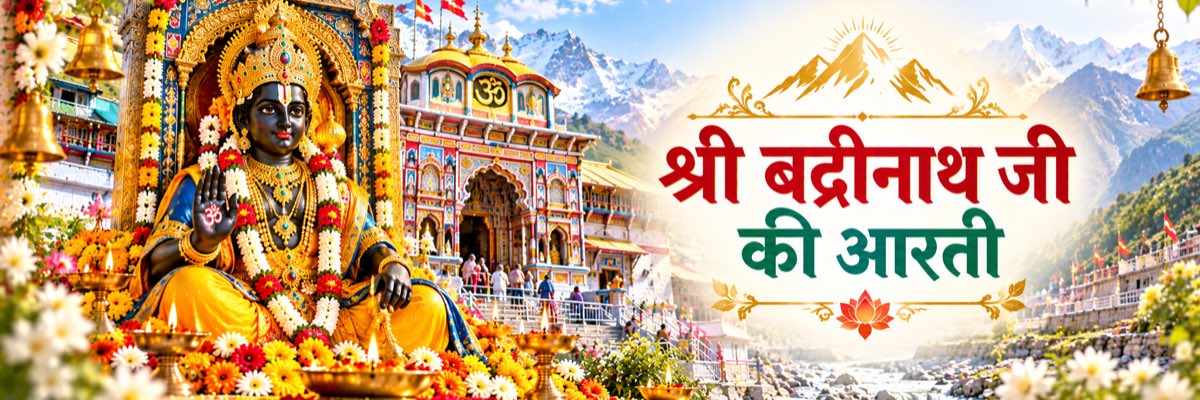
Badrinath, high in the Garhwal Himalayas on the bank of the Alaknanda, is one of the Char Dham and the holiest shrine of Vishnu in the north, where he is worshipped as Badri-Narayan seated in meditation. Its best-known aarti, "Pavan mand sugandh sheetal", opens with what every pilgrim notices first: the gentle, fragrant, cold mountain air, the golden-topped temple, and the clear river (here called Ganga — the Alaknanda is one of her head-streams) flowing right beside it. The refrain calls Badrinath Vishvambhara, "he who sustains the universe".
What each stanza pictures
- Stanza 2: Shesha remembers him day and night, Maheshvara (Shiva) meditates on him, and Brahma praises him with the Vedas.
- Stanza 3: Shakti, Gauri, Ganesha, Sharada and Narada sing of him — his play is endless yoga and meditation, fitting the image of Badri-Narayan in tapas.
- Stanza 4: Indra, Chandra and Kuber light the incense and lamps, and the siddhas and sages cry "Jai, jai". Kuber's presence is not just poetic: an image of Kuber stands in Badrinath's sanctum.
- Stanza 5: yakshas and kinnaras celebrate, gandharvas shine with knowledge, and Lakshmi herself waves the chamara.
- Stanza 6: the one stainless god of Kailash, Maheshvara of the mountain peaks — and King Yudhishthira, whose path to heaven passed this way, sings his praise.
- Stanza 7 (phala-shruti): reading these "five jewels" of Shri Badri destroys sin and brings the merit of ten million pilgrimages.
How it is sung
At the temple the aarti is sung in the evening, as the day's worship closes. Pilgrims who have been to Badrinath often sing it at home in the same slow, unhurried way, and it is sung at Vishnu temples and in Garhwali homes all over India. The temple is open roughly from late April or May until November, when the deity is taken down to Joshimath for the winter; the aarti is then sung there.
Who wrote it?
The question is debated. A widely repeated local story credits a Muslim devotee from Nandprayag, often named Badruddin; in recent years descendants of a Garhwali writer, Dhan Singh Bartwal, have produced a manuscript claiming it for him. Neither claim has been settled, and the sources we checked do not name an author. What is certain is that it has been the Badrinath aarti for well over a century.
Frequently asked questions
What does "Vishvambharam" mean?
"The sustainer of the universe" — a name of Vishnu, used here as the refrain for Badrinath.
Which "Ganga" flows near Badrinath?
The Alaknanda, one of the two head-streams that join at Devprayag to form the Ganga. The aarti calls it Ganga.
When is the Badrinath aarti sung?
In the temple's evening worship; at home it can be sung at any evening aarti of Vishnu, and especially on Ekadashi.
When is Badrinath temple open?
From around April–May (the date is announced on Basant Panchami) until around November. In winter the worship moves to Joshimath.
Who are the "panch ratna" in the last stanza?
The phrase calls the aarti's stanzas the "five jewels" of Badri; reciting them is said to destroy sins and give the fruit of countless pilgrimages.
Spotted a mistake?
If you find any grammatical, Hindi, English, mantra-text or other mistake on this page, tell us — we will correct it within 24 hours.