
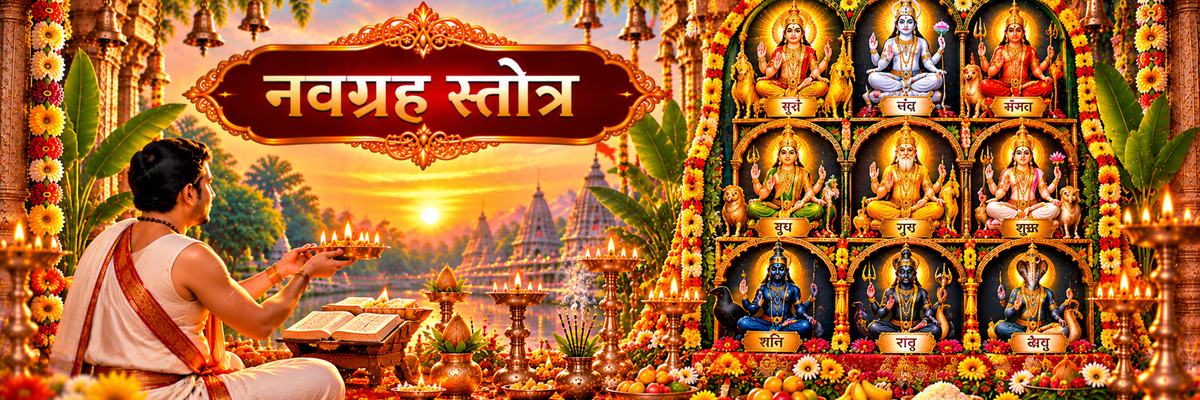
Original text
जपाकुसुमसंकाशं काश्यपेयं महाद्युतिम् । तमोऽरिं सर्वपापघ्नं प्रणतोऽस्मि दिवाकरम् ॥ १ ॥ दधिशङ्खतुषाराभं क्षीरोदार्णवसंभवम् । नमामि शशिनं सोमं शम्भोर्मुकुटभूषणम् ॥ २ ॥ धरणीगर्भसंभूतं विद्युत्कान्तिसमप्रभम् । कुमारं शक्तिहस्तं तं मङ्गलं प्रणमाम्यहम् ॥ ३ ॥ प्रियङ्गुकलिकाश्यामं रूपेणाप्रतिमं बुधम् । सौम्यं सौम्यगुणोपेतं तं बुधं प्रणमाम्यहम् ॥ ४ ॥ देवानां च ऋषीणां च गुरुं काञ्चनसंनिभम् । बुद्धिभूतं त्रिलोकेशं तं नमामि बृहस्पतिम् ॥ ५ ॥ हिमकुन्दमृणालाभं दैत्यानां परमं गुरुम् । सर्वशास्त्रप्रवक्तारं भार्गवं प्रणमाम्यहम् ॥ ६ ॥ नीलांजनसमाभासं रविपुत्रं यमाग्रजम् । छायामार्तण्डसंभूतं तं नमामि शनैश्चरम् ॥ ७ ॥ अर्धकायं महावीर्यं चन्द्रादित्यविमर्दनम् । सिंहिकागर्भसंभूतं तं राहुं प्रणमाम्यहम् ॥ ८ ॥ पलाशपुष्पसंकाशं तारकाग्रहमस्तकम् । रौद्रं रौद्रात्मकं घोरं तं केतुं प्रणमाम्यहम् ॥ ९ ॥ इति व्यासमुखोद्गीतं यः पठेत्सुसमाहितः । दिवा वा यदि वा रात्रौ विघ्नशान्तिर्भविष्यति ॥ १० ॥ नरनारीनृपाणां च भवेद्दुःस्वप्ननाशनम् । ऐश्वर्यमतुलं तेषामारोग्यं पुष्टिवर्धनम् ॥ ग्रहनक्षत्रजाः पीडास्तस्कराग्निसमुद्भवाः । ताः सर्वाः प्रशमं यान्ति व्यासो ब्रूते न संशयः ॥ ॥ इति श्रीव्यासविरचितं नवग्रहस्तोत्रं सम्पूर्णम् ॥
Transliteration
Japakusumasankasham kashyapeyam mahadyutim Tamo'rim sarvapapaghnam pranato'smi divakaram ||1|| Dadhishankhatusharabham kshirodarnavasambhavam Namami shashinam somam shambhormukutabhushanam ||2|| Dharanigarbhasambhutam vidyutkantisamaprabham Kumaram shaktihastam tam mangalam pranamamyaham ||3|| Priyangukalikashyamam rupenapratimam budham Saumyam saumyagunopetam tam budham pranamamyaham ||4|| Devanam cha rishinam cha gurum kanchanasannibham Buddhibhutam trilokesham tam namami brihaspatim ||5|| Himakundamrinalabham daityanam paramam gurum Sarvashastrapravaktaram bhargavam pranamamyaham ||6|| Nilanjanasamabhasam raviputram yamagrajam Chhayamartandasambhutam tam namami shanaishcharam ||7|| Ardhakayam mahaviryam chandradityavimardanam Simhikagarbhasambhutam tam rahum pranamamyaham ||8|| Palashapushpasankasham tarakagrahamastakam Raudram raudratmakam ghoram tam ketum pranamamyaham ||9|| Iti vyasamukhodgitam yah pathetsusamahitah Diva va yadi va ratrau vighnashantirbhavishyati ||10|| Naranarinripanam cha bhaveddusvapnanashanam Aishvaryamatulam teshamarogyam pushtivardhanam || Grahanakshatrajah pidastaskaragnisamudbhavah Tah sarvah prashamam yanti vyaso brute na samshayah ||
Nine verses, nine planets
The Navagraha Stotra is one of the simplest and most widely recited hymns to the nine "graspers" (grahas) of Indian astrology. There is one verse for each, in the order of the weekdays and then the two lunar nodes: Surya (Sun), Chandra (Moon), Mangal (Mars), Budh (Mercury), Brihaspati (Jupiter), Shukra (Venus), Shani (Saturn), Rahu and Ketu. Its closing verses call it Vyasa-mukhodgitam, "sung from the mouth of Vyasa", and the tradition attributes it to the compiler of the Vedas and Puranas.
A colour, a birth and a nature for each
Every verse follows the same pattern: what the planet looks like, where it came from, and what it is. Read together, they give the iconography used in Navagraha shrines:
- Surya: bright as the japa (hibiscus) flower, son of Kashyapa, of great radiance, enemy of darkness, destroyer of all sins.
- Chandra: white as curd, conch and snow, born from the ocean of milk, the ornament on Shiva's crown.
- Mangal: born from the womb of the Earth, glowing like lightning, a youth holding a spear.
- Budh: dark as the priyangu bud, of matchless beauty, gentle and of gentle qualities.
- Brihaspati: guru of the gods and sages, golden, the embodiment of intelligence, lord of the three worlds.
- Shukra: white as snow, jasmine and lotus fibre, the supreme guru of the daityas, expounder of every shastra, of Bhrigu's line.
- Shani: dark as blue collyrium, son of the Sun and elder brother of Yama, born of Chhaya and Martanda.
- Rahu: half-bodied and mighty, tormentor of the Sun and Moon (in eclipses), born of Simhika.
- Ketu: red as the palasha flower, head of the stars and planets, fierce and terrible.
These colours (red, white, red, green, gold, white, dark blue, smoky and flame-coloured) are the same ones used in traditional graha shanti, from the cloth and grain offered to each planet to the gems associated with it.
What the closing verses promise
The phala verses are typical of protective stotras. Recited with a settled mind, by day or by night, it brings peace from obstacles. For men, women and kings alike it ends bad dreams and brings unequalled prosperity, health and strength. All afflictions arising from the planets and stars, and from thieves and fire, are calmed: Vyaso brute na samshayah, "Vyasa says so, without doubt".
How it is used
The stotra is recited daily by many as a general prayer for balance in life, and it is the standard recitation at Navagraha puja and graha shanti ceremonies, at the start of a new home, after a difficult horoscope reading, and at Navagraha shrines in temples. Some people recite just the verse of the planet ruling that weekday: Surya on Sunday, Chandra on Monday, and so on, with Rahu and Ketu on Saturday. It is a prayer, not a substitute for good judgement; tradition offers it as a way to meet difficult times calmly, and its own phala speaks of peace (shanti) above all.
Spotted a mistake?
If you find any grammatical, Hindi, English, mantra-text or other mistake on this page, tell us — we will correct it within 24 hours.