
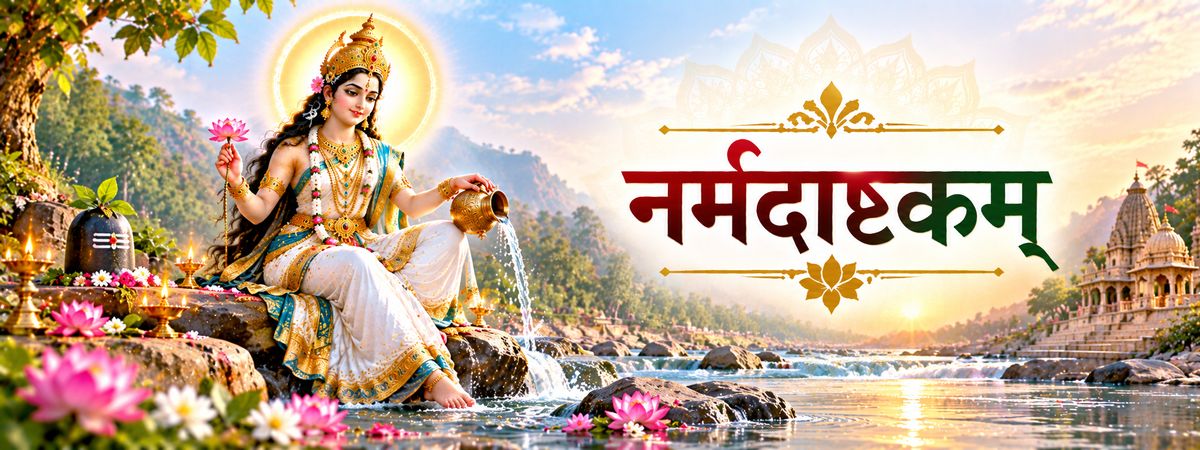
Original text
सबिन्दुसिन्धुसुस्खलत्तरङ्गभङ्गरञ्जितं द्विषत्सु पापजातजातकारिवारिसंयुतम् । कृतान्तदूतकालभूतभीतिहारिवर्मदे त्वदीयपादपङ्कजं नमामि देवि नर्मदे ॥ १॥ त्वदम्बुलीनदीनमीनदिव्यसम्प्रदायकं कलौ मलौघभारहारिसर्वतीर्थनायकम् । सुमच्छकच्छनक्रचक्रवाकचक्रशर्मदे त्वदीयपादपङ्कजं नमामि देवि नर्मदे ॥ २॥ महागभीरनीरपूरपापधूतभूतलं ध्वनत्समस्तपातकारिदारितापदाचलम् । जगल्लये महाभये मृकण्डुसूनुहर्म्यदे त्वदीयपादपङ्कजं नमामि देवि नर्मदे ॥ ३ ॥ गतं तदैव मे भयं त्वदम्बु वीक्षितं यदा मृकण्डुसूनुशौनकासुरारिसेवितं सदा । पुनर्भवाब्धिजन्मजं भवाब्धिदुःखवर्मदे त्वदीयपादपङ्कजं नमामि देवि नर्मदे ॥ ४॥ अलक्ष्यलक्षकिन्नरामरासुरादिपूजितं सुलक्षनीरतीरधीरपक्षिलक्षकूजितम् । वसिष्ठशिष्टपिप्पलादिकर्दमादिशर्मदे त्वदीयपादपङ्कजं नमामि देवि नर्मदे ॥ ५॥ सनत्कुमारनाचिकेतकश्यपात्रिषट्पदैः धृतं स्वकीयमानसेषु नारदादिषट्पदैः । रवीन्दुरन्तिदेवदेवराजकर्मशर्मदे त्वदीयपादपङ्कजं नमामि देवि नर्मदे ॥ ६॥ अलक्षलक्षलक्षपापलक्षसारसायुधं ततस्तु जीवजन्तुतन्तुभुक्तिमुक्तिदायकम् । विरिञ्चिविष्णुशंकरस्वकीयधामवर्मदे त्वदीयपादपङ्कजं नमामि देवि नर्मदे ॥ ७॥ अहो धृतं स्वनं श्रुतं महेशकेशजातटे किरातसूतबाडबेषु पण्डिते शठे नटे । दुरन्तपापतापहारि सर्वजन्तुशर्मदे त्वदीयपादपङ्कजं नमामि देवि नर्मदे ॥ ८॥ इदं तु नर्मदाष्टकं त्रिकालमेव ये सदा पठन्ति ते निरन्तरं न यान्ति दुर्गतिं कदा । सुलभ्यदेहदुर्लभं महेशधामगौरवं पुनर्भवा नरा न वै विलोकयन्ति रौरवम् ॥ ९॥ इति श्रीमत्परमहंसपरिव्राजकाचार्यस्य श्रीगोविन्दभगवत्पूज्यपादशिष्यस्य श्रीमच्छंकरभगवतः कृतौ नर्मदाष्टकं सम्पूर्णम् ॥
Transliteration
Sabindusindhususkhalattarangabhangaranjitam Dvishatsu papajatajatakarivarisanyutam | Kritantadutakalabhutabhitiharivarmade Tvadiyapadapankajam namami devi narmade ||1|| Tvadambulinadinaminadivyasampradayakam Kalau malaughabharaharisarvatirthanayakam | Sumachchhakachchhanakrachakravakachakrasharmade Tvadiyapadapankajam namami devi narmade ||2|| Mahagabhiranirapurapapadhutabhutalam Dhvanatsamastapatakaridaritapadachalam | Jagallaye mahabhaye mrikandusunuharmyade Tvadiyapadapankajam namami devi narmade ||3|| Gatam tadaiva me bhayam tvadambu vikshitam yada Mrikandusunushaunakasurarisevitam sada | Punarbhavabdhijanmajam bhavabdhiduhkhavarmade Tvadiyapadapankajam namami devi narmade ||4|| Alakshyalakshakinnaramarasuradipujitam Sulakshaniratiradhirapakshilakshakujitam | Vasishthashishtapippaladikardamadisharmade Tvadiyapadapankajam namami devi narmade ||5|| Sanatkumaranachiketakashyapatrishatpadaih Dhritam svakiyamanaseshu naradadishatpadaih | Ravindurantidevadevarajakarmasharmade Tvadiyapadapankajam namami devi narmade ||6|| Alakshalakshalakshapapalakshasarasayudham Tatastu jivajantutantubhuktimuktidayakam | Virinchivishnushankarasvakiyadhamavarmade Tvadiyapadapankajam namami devi narmade ||7|| Aho dhritam svanam shrutam maheshakeshajatate Kiratasutabadabeshu pandite shathe nate | Durantapapatapahari sarvajantusharmade Tvadiyapadapankajam namami devi narmade ||8|| Idam tu narmadashtakam trikalameva ye sada Pathanti te nirantaram na yanti durgatim kada | Sulabhyadehadurlabham maheshadhamagauravam Punarbhava nara na vai vilokayanti rauravam ||9|| Iti shrimatparamahansaparivrajakacharyasya Shrigovindabhagavatpujyapadashishyasya Shrimachchhankarabhagavatah kritau Narmadashtakam sampurnam ||
A hymn you can hear the river in
The Narmadashtakam is written in a metre (panchachamara) of strictly alternating short and long syllables, which gives it a rushing, rolling rhythm like water over rocks. Its opening words, sabindu-sindhu-suskhalat-taranga-bhanga-ranjitam, describe the river's spray-flecked, tumbling waves. It is attributed to Adi Shankaracharya, who according to tradition met his guru Govindapada on the banks of the Narmada at Omkareshwar, and it is the evening aarti hymn at ghats from Amarkantak to Omkareshwar.
What the verses say
- 1: her water, charming with waves and spray, destroys the sins of the hostile; she is armour (varma) against the fear of death's messengers.
- 2: even the humble fish who dissolve in her water gain a divine state; in the Kali age she removes the load of impurity and is chief of all tirthas; she gives joy to fish, tortoises, crocodiles and chakravaka birds.
- 3–4: her deep waters wash the earth; in the great dissolution she sheltered the sage Markandeya (son of Mrikandu); "my fear vanished the moment I saw your water", served always by Markandeya, Shaunaka and the gods.
- 5–6: worshipped by countless kinnaras, gods and asuras, her banks echo with birds; she gives joy to Vasishtha, Pippalada and Kardama; Sanatkumara, Nachiketa, Kashyapa, Atri and Narada hold her in their hearts like bees at a lotus.
- 7: she destroys lakhs of sins and gives both enjoyment and liberation to every creature; she is the armour leading to the abodes of Brahma, Vishnu and Shiva.
- 8: born from Mahesha's matted hair, she removes sin for hunter and charioteer, scholar, rogue and actor alike.
- 9: those who read this Narmadashtakam at the three times of day never fall into misfortune, attain Shiva's abode and never see hell.
When to recite it
- At the evening Narmada aarti at her ghats, and on Narmada Jayanti (Magh shukla saptami).
- Throughout a Narmada parikrama, often daily.
- At home before a Narmadeshwar Shivalinga.
Frequently asked questions
Who wrote the Narmadashtakam?
It is attributed to Adi Shankaracharya; the colophon calls it the work of the disciple of Govinda Bhagavatpada.
Why does it sound so rhythmic?
It uses the panchachamara metre, in which short and long syllables alternate, giving a rushing, galloping sound.
Who is Mrikandu's son in the hymn?
Sage Markandeya, who in Puranic legend survived the cosmic dissolution on the Narmada's banks.
When is Narmada Jayanti?
On Magh shukla saptami, usually in January or February.
What does "namami devi narmade" mean?
"I bow to you, Goddess Narmada"; the full refrain bows to her lotus feet.
Spotted a mistake?
If you find any grammatical, Hindi, English, mantra-text or other mistake on this page, tell us — we will correct it within 24 hours.