Where the story comes from
Dhruva's story is told in the fourth canto of the Shrimad Bhagavatam (chapters 8 to 12), narrated by the sage Maitreya to Vidura, and also in the first book of the Vishnu Purana. Dhruva belongs to the very first human lineage: his grandfather is Svayambhuva Manu, and his great-grandfather is Brahma himself. The details below follow the Bhagavatam's telling.
A seat denied
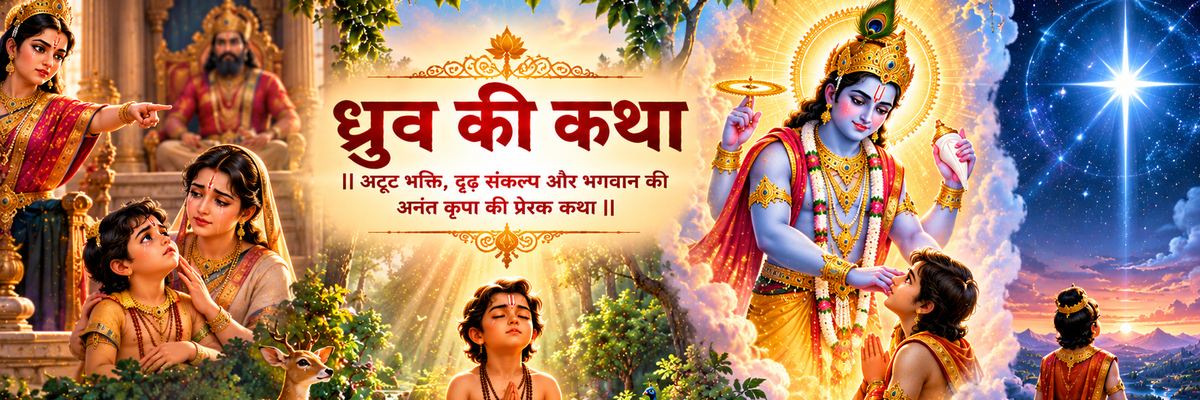
King Uttanapada had two queens. Suruchi was his favourite and the mother of his son Uttama; Suniti, the mother of Dhruva, was neglected. One day, while the king had Uttama on his lap, the young Dhruva tried to climb up too. The king did not welcome him, and Suruchi, loud enough for the king to hear, told Dhruva that being the king's son was not enough: since he had not been born from her womb, he had no right to his father's lap or throne. If he wanted it, she said, he should go and worship Narayana, and hope to be reborn as her son. The king said nothing. Dhruva, hissing with anger "like a snake struck with a stick", as the text puts it, ran to his mother.
A mother's advice
Suniti was as hurt as her son, but her answer is one of the quieter turning points of the story. She told him not to wish harm on anyone, since whoever causes pain suffers it in return, and admitted that her co-wife's words, however cruel, held a truth: only the Lord could remedy what had happened. She reminded him that Brahma and his own grandfather Manu had reached their positions through worship of Vishnu, and told him to take shelter in Him. Dhruva left the palace that same day.
Narada's test and the mantra
On the way, the sage Narada met him and tried to talk him out of it. He was only a child, Narada said; yogis had spent lifetimes without reaching God, so he should go home and try when he was older. Dhruva refused. He said his heart was broken by his stepmother's words, and he wanted a position higher than any his forefathers had held. Seeing his determination, Narada became his guru. He sent him to Madhuvana, a forest on the banks of the Yamuna in the Vrindavan area, and gave him the twelve-syllable mantra Om Namo Bhagavate Vasudevaya, together with a description of Vishnu's form to meditate on.
Six months in Madhuvana
The Bhagavatam gives Dhruva's austerity month by month. In the first month he ate fruits and berries once every three days; in the second, dry grass and leaves once every six days; in the third, only water once every nine days; in the fourth he took a breath only every twelfth day. By the fifth month he stood motionless on one leg, his mind fixed entirely on the Lord. The text says the pressure of his big toe tilted the earth, and that because he had stopped his own breath, the breath of the whole universe was choked, so the gods went to Vishnu for help. Vishnu reassured them and came to Madhuvana on Garuda.
The vision, and a boy who couldn't speak
Dhruva had been seeing the Lord in his heart. When that inner image suddenly disappeared, he opened his eyes and found Vishnu standing in front of him. He fell to the ground, wanting to offer prayers, but as a small child he did not know how. Vishnu touched his forehead with His conch, and at once Dhruva understood the Vedic truth and spoke a prayer. The prayer is still read today. In it Dhruva says that anyone who worships the Lord for bodily comforts is like a fool who asks a wish-fulfilling tree for things even beings in hell can get.
The boon, and his regret
Vishnu gave Dhruva what he had set out for, and more. He would rule his father's kingdom for thirty-six thousand years without ageing. After that he would reach Dhruvaloka, the pole star: a realm no one had ruled before, around which all the stars and the seven sages revolve, and which survives even the dissolution at the end of the cosmic cycle. Yet Dhruva went home sad. Having seen the Lord face to face, he was ashamed that he had asked for a kingdom and gone looking for revenge against his stepmother. He compared himself to a poor man who pleases an emperor and then asks for a handful of broken rice. That regret is exactly why devotional traditions admire him.
What happened afterwards
His father, who had been sorry since the day Dhruva left, welcomed him back with great celebration and later gave him the throne. As Vishnu had foretold, Uttama was killed by a Yaksha while hunting in the Himalayas, and Suruchi, searching for her son, died in a forest fire. Grieving and angry, Dhruva went to war against the Yakshas and killed them in great numbers, until his grandfather Manu came and stopped him. Manu reminded him that one man's crime did not justify killing so many, and that the Yakshas were followers of Kuvera and Shiva. Dhruva stopped, and Kuvera himself blessed him. At the end of his reign he boarded a celestial chariot sent by Vishnu, stepping on the head of Death itself to climb in. He asked that his mother Suniti not be left behind, and was shown that she was already travelling ahead of him.
Why the story is told
Dhruva's name means "fixed" or "unmoving", and that is the point of the story: a child's single-minded determination can reach what yogis struggle for over lifetimes. It is also a story about motive. He began with a wounded ego and a wish to outrank his stepbrother, and was changed by the very devotion he began for selfish reasons. That is why the Om Namo Bhagavate Vasudevaya mantra is so closely linked to his name, and why the pole star, the one star that does not move, is still called Dhruva tara in Hindi.