Maa Gayatri
Vedamata, the mother of the Vedas: the Gayatri Mantra worshipped as a goddess, with five faces and ten arms, invoked at every sandhya.
A mantra who became a goddess
Maa Gayatri is unusual among Hindu deities: she began as a verse. The Gayatri Mantra, Om bhur bhuvah svah, tat savitur varenyam, bhargo devasya dhimahi, dhiyo yo nah prachodayat, is a hymn of the Rigveda (3.62.10) seen by the sage Vishvamitra and addressed to Savitr, the divine light that impels the sun. "Gayatri" is the name of its metre: twenty-four syllables in three lines of eight. Over centuries the mantra itself came to be worshipped as a goddess, the power that the words carry. That is why she is called Vedamata, the mother of the Vedas, and why tradition says that whoever knows the Gayatri holds the essence of all four.
How she is pictured
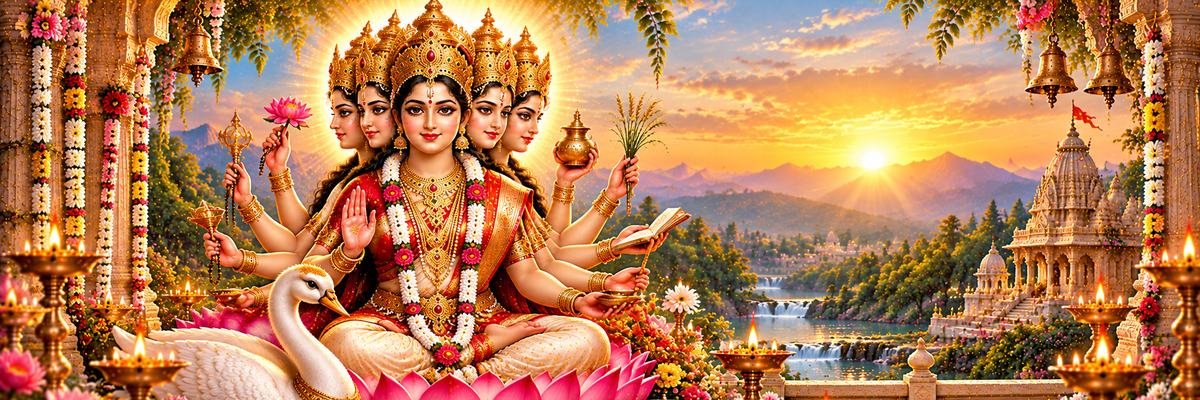
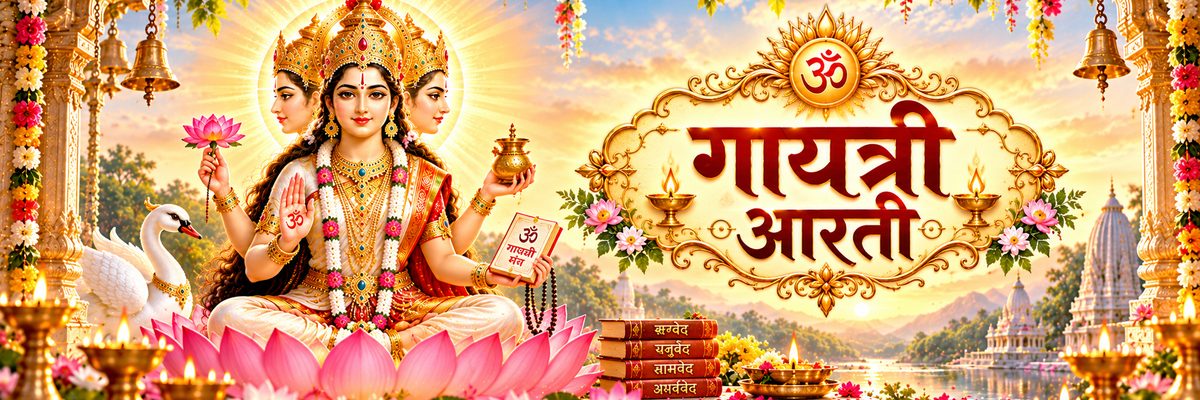
Her best-known image has five faces and ten arms. The faces are described as pearl-white, coral-red, golden, blue-black and pure white, and are read as the five elements or the five breaths. Her classical dhyana verse, which begins mukta-vidruma-hema-nila-dhavala, gives her ten hands: two in the gestures of granting boons and fearlessness, and the others holding a goad, a whip, a white skull-cup, a rope, a conch, a discus and a pair of lotuses. She sits on a red lotus, and her mount is a swan, the bird of discernment she shares with Saraswati. Household pictures, especially those of the Gayatri Pariwar, often show a simpler form: one face, two or four arms, a book and a pot, seated on a swan with the sun rising behind her.
One goddess at three sandhyas
The mantra is meant to be recited at the three junctions of the day, the sandhyas, and the goddess takes a different form at each:
- Gayatri at dawn: a young girl, red, with Brahma's power, riding a swan.
- Savitri at midday: a young woman, with Vishnu's power, riding Garuda.
- Saraswati at dusk: an older woman, white, with Shiva's power, riding a bull.
This is how the sandhya prayers make one goddess the whole of the Trimurti's power across one day. In some Puranic stories, notably the Pushkar tradition in Rajasthan, Gayatri is also Brahma's consort, which is why Pushkar has a Gayatri shrine on a hill opposite the Savitri temple.
Gayatri japa and the sacred thread
The Gayatri Mantra is the mantra given at the upanayana, the sacred thread ceremony, and for traditional Brahmin families its daily recitation at sandhya is a lifelong duty. Japa is usually 108 times on a mala, sitting facing east in the morning and west in the evening. The prayer itself asks for nothing worldly. It asks only that the divine light inspire our understanding, which is why it is called the prayer for a clear mind. In the twentieth century, reformers including the Arya Samaj and Pandit Shriram Sharma Acharya, who founded the All World Gayatri Pariwar and its centre Shantikunj in Haridwar, opened Gayatri japa to everyone regardless of caste or gender, and today it is recited by millions.
Gayatri Jayanti and when to worship her
Gayatri Jayanti, her appearance day, is observed in much of north India on Jyeshtha Shukla Ekadashi, close to Ganga Dussehra; some traditions mark it on Shravan Purnima instead, the day the sacred thread is renewed. Navaratri, especially the Gupt Navaratris, is a favoured time for long courses of japa called anushthana, often 24,000 repetitions in nine days. At home, a lamp, a few flowers, a short dhyana of her form, japa of the mantra and the Gayatri Chalisa are a complete puja.
Mantra
Stotra
Chalisa
Aarti
Puja Vidhi
Spotted a mistake?
If you find any grammatical, Hindi, English, mantra-text or other mistake on this page, tell us — we will correct it within 24 hours.