
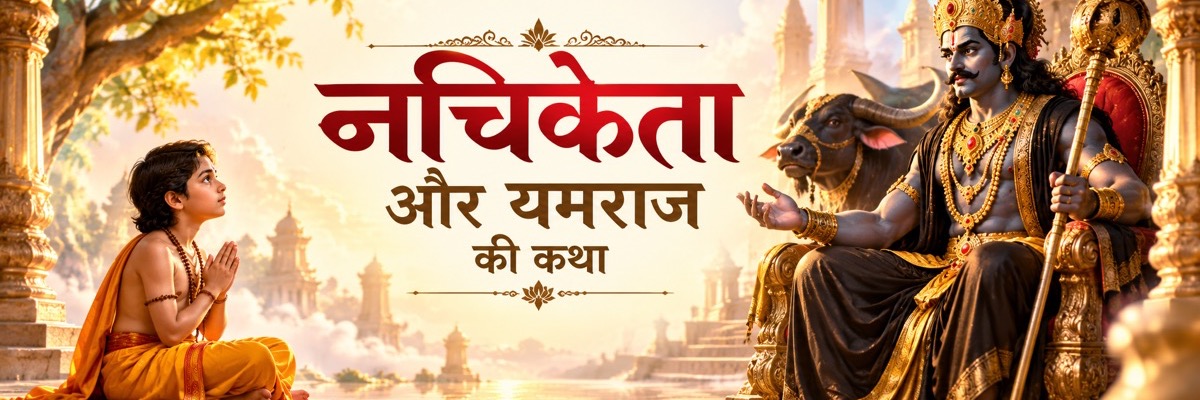
Where the story comes from
Nachiketa's story is the frame of the Katha Upanishad, one of the principal Upanishads, belonging to the Krishna Yajurveda. A shorter version appears in the Taittiriya Brahmana, and the Mahabharata retells it. The account below follows the Katha Upanishad, whose teaching on the Self has been central to Vedanta ever since.
The father's gift
The Upanishad opens: उशन्ह वै वाजश्रवसः सर्ववेदसं ददौ । तस्य ह नचिकेता नाम पुत्र आस ॥ — "Desiring reward, Vajashravasa gave away all his possessions. He had a son named Nachiketa." The father was performing the Vishvajit sacrifice, in which everything one owns is given away. But the cows he was giving were worn out — the Upanishad describes them as cows that "have drunk their water, eaten their grass, given their milk, and are barren" — and the boy, though young, was troubled: one who gives such gifts, he thought, goes to joyless worlds.
So he asked his father, "To whom will you give me?" He asked a second time, and a third. At last the father snapped: "To Death I give you!" (mṛtyave tvā dadāmi).
Three nights at Yama's door
Nachiketa took his father's words as binding and went to the house of Yama, the lord of death. Yama was away, and the boy waited at the door for three nights without food or water. When Yama returned, he was told that a brahmin guest had waited unfed in his house — a grave fault for any host. To make amends, Yama offered Nachiketa three boons, one for each night.
The three boons
- Peace for his father. "Let my father be calm and no longer angry with me, and recognise and welcome me when I return." Yama granted it at once.
- The fire that leads to heaven. Nachiketa asked to know the fire-sacrifice that leads to the heavenly world. Yama taught it to him, and was so pleased with how quickly the boy repeated it that he named the fire after him — the Nachiketa fire — and gave him a jewelled garland besides.
- The secret of death. "When a man dies, some say he exists and some say he does not. I want to know this from you." Here Yama hesitated. "Even the gods had doubts about this; it is subtle and not easily known. Choose another boon."
The temptation
Yama offered him everything else: sons and grandsons who would live a hundred years, herds of cattle, elephants, gold and horses, a vast kingdom, life for as many years as he wished, and heavenly women with chariots and music, such as no mortal can have. Nachiketa refused them all:
श्वोभावा मर्त्यस्य यदन्तकैतत्सर्वेन्द्रियाणां जरयन्ति तेजः — "These last only till tomorrow, O Death, and they wear out the vigour of the senses. Even the longest life is short. Keep your horses, your dances and songs." No one, he said, can be satisfied by wealth; he would ask for nothing but the answer.
What Yama taught
Pleased, Yama began the teaching that fills the rest of the Upanishad.
- The good and the pleasant: श्रेयश्च प्रेयश्च मनुष्यमेतः — "The good and the pleasant both approach a person. The wise one examines them and chooses the good over the pleasant; the fool chooses the pleasant for the sake of getting and keeping." Nachiketa, Yama says, has chosen the good.
- The Self does not die: न जायते म्रियते वा विपश्चित् — "The knowing Self is not born and does not die… unborn, eternal, everlasting, ancient, it is not killed when the body is killed." The same verse appears, almost word for word, in the Bhagavad Gita (2.20).
- The chariot: आत्मानं रथिनं विद्धि शरीरं रथमेव तु — "Know the Self as the rider, the body as the chariot, the intellect as the charioteer, and the mind as the reins." The senses are the horses; whoever has a disciplined mind reaches the goal.
- The call to wake: उत्तिष्ठत जाग्रत प्राप्य वरान्निबोधत — "Arise, awake, and learn by approaching the great. Sharp as a razor's edge, the sages say, is that path — hard to cross."
Having received this knowledge, the Upanishad ends, Nachiketa became free of passion and of death, and attained Brahman — and so will anyone else who knows the Self in this way.
What the story teaches
- Integrity even in a child. Nachiketa takes his father's angry words seriously and keeps them, at the cost of his life.
- Choosing the lasting over the pleasant. Offered everything the world can give, he wants only the truth.
- Death as a teacher. The one thing everyone fears becomes, for the sincere seeker, the door to knowledge.
Swami Vivekananda often held up Nachiketa's faith (shraddha) as the ideal for young people, and made "Arise, awake…" one of his most famous calls.
Frequently asked questions
Which Upanishad tells the story of Nachiketa?
The Katha Upanishad (Kathopanishad) of the Krishna Yajurveda.
Who was Nachiketa's father?
Vajashravasa, also called Auddalaki Aruni Gautama in the Upanishad, who gave away his wealth in the Vishvajit sacrifice.
What were Nachiketa's three boons?
His father's peace and welcome on his return; knowledge of the fire-sacrifice that leads to heaven (named the Nachiketa fire); and the truth about what happens after death.
What does "shreya" and "preya" mean?
Shreya is the good — what leads to lasting welfare; preya is the pleasant — what is enjoyable now. The wise choose shreya.
Where does "Uttishthata jagrata" come from?
From the Katha Upanishad (1.3.14), in Yama's teaching to Nachiketa. Swami Vivekananda made it famous as a call to action.
Is the Katha Upanishad related to the Bhagavad Gita?
Yes — several verses, such as "na jayate mriyate va", appear in both in nearly the same words, and the chariot image is echoed in the Gita's teaching on the mind and senses.
Spotted a mistake?
If you find any grammatical, Hindi, English, mantra-text or other mistake on this page, tell us — we will correct it within 24 hours.