
Where the story comes from
The story of Gajendra is told in the Shrimad Bhagavatam, Canto 8, chapters 2 to 4, where Shuka narrates it to King Parikshit. Chapter 3 is the elephant's prayer, the Gajendra Moksha Stotram; chapters 2 and 4 tell the story around it. The retelling below follows the Bhagavatam.
The mountain and the lake
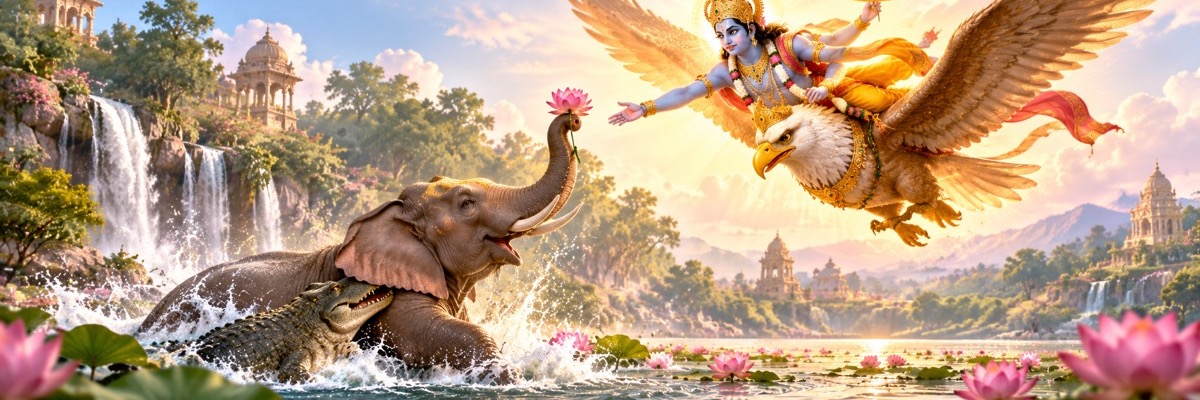
In the ocean of milk stands Mount Trikuta, with three great peaks of iron, silver and gold, its slopes full of forests, waterfalls and wild animals. In one of its valleys lies a garden of Varuna, and in the garden a lake of clear water covered with golden lotuses. There lived Gajendra, the lord of elephants, leading a great herd of elephants and their young.
The crocodile
One hot day Gajendra, with his wives and calves, came down to the lake. He drank, sprayed water over himself and the others, and played in the water like a householder absorbed in his family. In that moment a powerful crocodile seized his leg.
Gajendra pulled with all his strength; his wives and companions tried to help him; but they could not free him. The Bhagavatam says the struggle went on for a thousand years — the elephant pulling towards the shore, the crocodile pulling into the water, which was its own element. Slowly the elephant's strength drained away, while the crocodile in its home grew stronger. The herd, unable to help, gave up and left.
The prayer
At the edge of death, Gajendra understood that no one — not his herd, not his strength — could save him. "Even the gods cannot save one in such danger," he thought; "I take refuge in the Supreme, out of fear of whom even death runs." Fixing his mind in his heart, he recited a prayer he had learned in a previous life. It does not call on any form of God but on the Supreme Being as pure consciousness, the cause beyond all causes — and it ends with Gajendra saying that he no longer wants to live in an elephant's body: he wants freedom from ignorance itself.
The Lord comes
Because Gajendra had praised the Supreme without naming any form, Brahma and the other gods, who each identify with their own form, did not come. Then Hari, the Self of all gods, came himself, riding on Garuda with his discus in hand. Seeing him in the sky, the elephant lifted a lotus in his trunk and with great effort cried, "Narayana, teacher of all, Lord — I bow to you." Hari came down at once, pulled the elephant and the crocodile together out of the lake, and with his discus cut open the crocodile's mouth to free Gajendra, while the gods watched and showered flowers.
Who they were
- The crocodile had been a Gandharva named Huhu. He had pulled at the leg of the sage Devala as he bathed, and the sage cursed him to become a crocodile. Struck by the discus, he regained his form, bowed to the Lord, and returned to his world.
- Gajendra had been King Indradyumna, a Pandya ruler devoted to Vishnu. Once, sitting in silent worship, he failed to rise and greet the sage Agastya, who cursed him to be born as an elephant — a creature of dull mind. Because of his devotion, the prayer he had learned as a king came back to him as an elephant. Touched by the Lord, he was freed and received a form like the Lord's own, as his associate.
The Lord then said that whoever rises at the end of night and remembers this story — the lake, the mountain, the elephant and his prayer — is freed from sin and remembers him at the end.
What the story teaches
- Surrender comes when self-reliance ends. For a thousand years Gajendra relied on his strength and his herd; the Lord came only when he relied on nothing else.
- The crocodile is time and attachment. Commentators read the lake as the pleasures of family life and the crocodile as death, which seizes us while we are absorbed in them.
- Grace is not earned by form. An elephant, a "lower" creature, is saved — because devotion learned in an earlier life was not lost.
Where it is remembered
The story is told during the Kartik month and on Ekadashi. At Sonepur in Bihar, at the meeting of the Gandak and the Ganga, local tradition places the fight of the elephant and the crocodile; the great Kartik Purnima fair at the Harihar Nath temple there is linked to it.
Frequently asked questions
Where is the story of Gajendra Moksha in the scriptures?
In the Shrimad Bhagavatam, Canto 8, chapters 2–4. Chapter 3 is Gajendra's prayer.
How long did Gajendra fight the crocodile?
The Bhagavatam says a thousand years.
Who was Gajendra in his previous life?
King Indradyumna of the Pandya country, cursed by Agastya for not rising to greet him.
Who was the crocodile?
The Gandharva Huhu, cursed by the sage Devala.
What does "moksha" mean in Gajendra Moksha?
Both rescue from the crocodile and liberation itself — Gajendra was freed from his elephant body and became the Lord's associate.
When should the Gajendra Moksha story be read?
Traditionally at dawn, in times of difficulty, on Ekadashi and in Kartik.
Spotted a mistake?
If you find any grammatical, Hindi, English, mantra-text or other mistake on this page, tell us — we will correct it within 24 hours.