
Original text
आरती युगलकिशोर की कीजै । तन मन धन न्योछावर कीजै ॥ गौरश्याम मुख निरखन लीजै । हरि का रूप नयन भरि पीजै ॥ रवि शशि कोटि बदन की शोभा । ताहि निरखि मेरो मन लोभा ॥ ओढ़े नील पीत पट सारी । कुंजबिहारी गिरिवरधारी ॥ फूलन सेज फूल की माला । रत्न सिंहासन बैठे नंदलाला ॥ कंचन थार कपूर की बाती । हरि आए निर्मल भई छाती ॥ श्री पुरुषोत्तम गिरिवरधारी । आरती करें सकल नर नारी ॥ नंदनंदन बृजभान किशोरी । परमानंद स्वामी अविचल जोरी ॥
Transliteration
Aarti Yugal Kishor ki kijai, tan man dhan nyochhavar kijai. Gaur-Shyam mukh nirkhan lijai, Hari ka roop nayan bhari pijai. Ravi shashi koti badan ki shobha, taahi nirakhi mero man lobha. Odhe neel peet pat saari, Kunjbihari Girivardhari. Phoolan sej phool ki mala, ratna sinhasan baithe Nandlala. Kanchan thaar kapoor ki baati, Hari aaye nirmal bhai chhati. Shri Purushottam Girivardhari, aarti karen sakal nar naari. Nandnandan Brijbhan Kishori, Parmanand swami avichal jori.
Who are the "Yugal Kishore"?
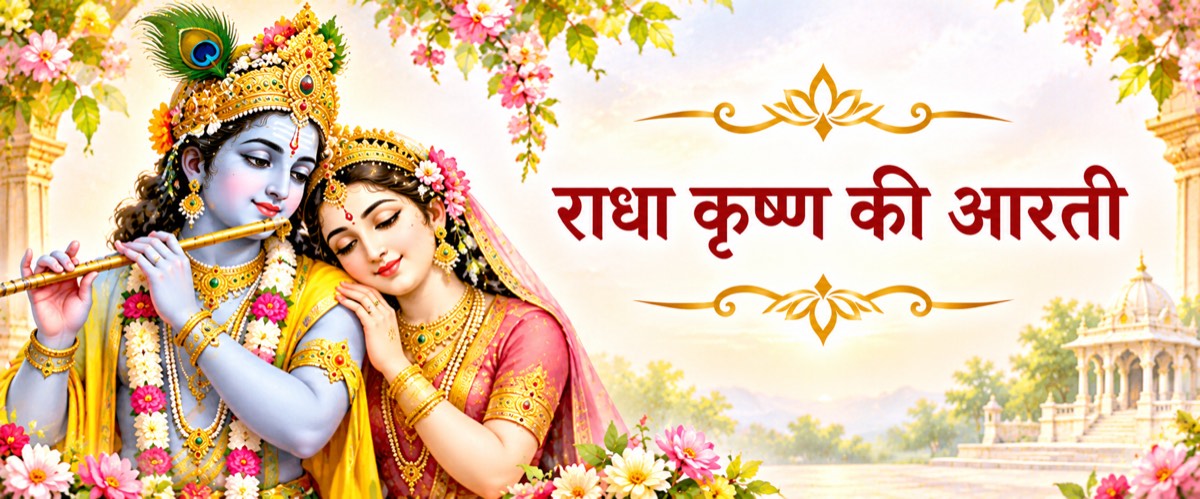
Yugal means "pair" and Kishore "youthful": the Yugal Kishore are Radha and Krishna as the eternal young couple of Vrindavan. In the Braj traditions, Krishna is never worshipped alone; Radha is his own joy and devotion, and the two are honoured together as one inseparable form. This aarti is sung in that spirit, and you will hear it in Braj temples and in homes where Radha-Krishna are worshipped side by side.
What the aarti says
- "Aarti Yugal Kishor ki kijai, tan man dhan nyochhavar kijai": perform the aarti of the divine couple, and offer up body, mind and wealth to them.
- "Gaur-Shyam mukh nirkhan lijai": gaze on the fair (gaur) face of Radha and the dark (shyam) face of Krishna, and "drink in Hari's form with your eyes".
- "Ravi shashi koti badan ki shobha": their faces shine with the beauty of millions of suns and moons, and seeing them my heart is captivated.
- "Odhe neel peet pat saari": Radha wears blue and Krishna yellow, the colours they are always shown in; he is Kunjbihari, who roams the groves, and Girivardhari, who held up Govardhan.
- "Phoolan sej... ratna sinhasan baithe Nandlala": a bed of flowers, garlands of flowers, Nanda's darling seated on a jewelled throne.
- "Kanchan thaar kapoor ki baati": a golden plate with a camphor flame; "Hari has come, and my heart is made pure".
- "Nandnandan Brijbhan Kishori": Nanda's son and Vrishabhanu's daughter, the unshakable pair (avichal jori).
The last line and the Pushtimarg
The closing words, Parmanand swami avichal jori, are traditionally read as the signature of Paramanand Das, one of the eight Ashtachhap poets of Vallabhacharya's Pushtimarg in sixteenth-century Braj: "the Lord of Paramanand is this unshakable pair". The phrase can also be heard simply as "the supremely blissful Lord", and both readings fit an aarti whose whole subject is the couple's inseparable bliss.
When and how it is sung
- At the evening aarti in Radha-Krishna temples and homes, especially on Radhashtami and Janmashtami.
- Through the month of Kartik, and on Ekadashi.
- Light a camphor or ghee lamp on a plate, wave it before Radha-Krishna, and follow with Aarti Kunj Bihari Ki and the Radha aarti Aarti Shri Vrishbhanusuta Ki.
Frequently asked questions
Whose aarti is "Aarti Yugal Kishore Ki Kije"?
The aarti of Radha and Krishna together, the "Yugal Kishore", the youthful divine couple of Vrindavan.
What does "Gaur-Shyam" mean?
Gaur (fair) is Radha and Shyam (dark) is Krishna. The aarti asks the devotee to gaze on both faces together.
Who wrote this aarti?
Its last line is traditionally read as the signature of Paramanand Das, an Ashtachhap poet of the Pushtimarg tradition in Braj.
When should it be sung?
At the evening aarti, and especially on Radhashtami, Janmashtami, Ekadashi and through Kartik month.
Can it be sung with Aarti Kunj Bihari Ki?
Yes. Many temples sing Kunj Bihari first for Krishna and then Yugal Kishore for the divine couple.
Spotted a mistake?
If you find any grammatical, Hindi, English, mantra-text or other mistake on this page, tell us — we will correct it within 24 hours.