Original text
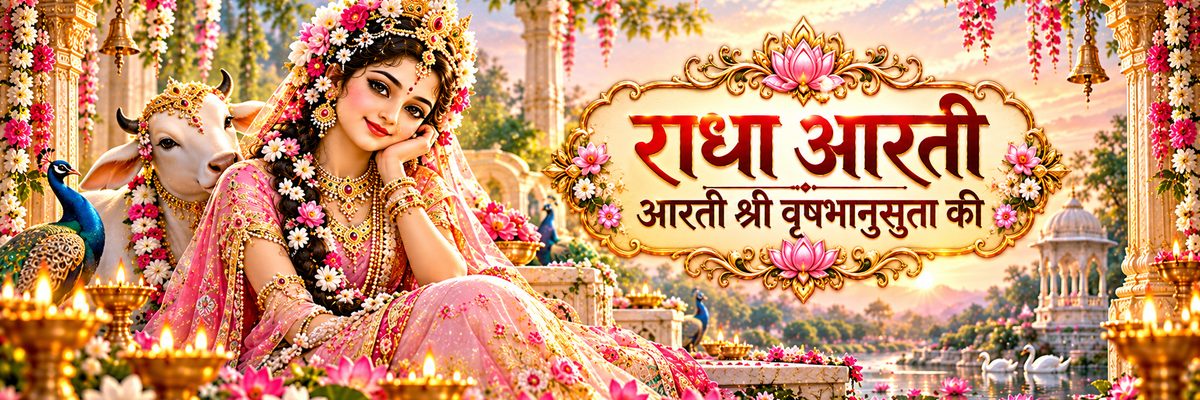
आरती श्री वृषभानुसुता की, मंजुल मूर्ति मोहन ममता की ॥ त्रिविध तापयुत संसृति नाशिनि, विमल विवेकविराग विकासिनि । पावन प्रभु पद प्रीति प्रकाशिनि, सुन्दरतम छवि सुन्दरता की ॥ ॥ आरती श्री वृषभानुसुता की..॥ मुनि मन मोहन मोहन मोहनि, मधुर मनोहर मूरति सोहनि । अविरलप्रेम अमिय रस दोहनि, प्रिय अति सदा सखी ललिता की ॥ ॥ आरती श्री वृषभानुसुता की..॥ संतत सेव्य सत मुनि जनकी, आकर अमित दिव्यगुन गनकी । आकर्षिणी कृष्ण तन मनकी, अति अमूल्य सम्पति समता की ॥ ॥ आरती श्री वृषभानुसुता की..॥ कृष्णात्मिका, कृष्ण सहचारिणि, चिन्मयवृन्दा विपिन विहारिणि । जगजननि जग दुखनिवारिणि, आदि अनादिशक्ति विभुता की ॥ ॥ आरती श्री वृषभानुसुता की..॥ आरती श्री वृषभानुसुता की, मंजुल मूर्ति मोहन ममता की ॥
Transliteration
Aarti Shri Vrishbhanusuta ki, Manjul murti Mohan mamta ki. Trividh taapyut sansriti naashini, Vimal vivek-viraag vikaasini. Paavan prabhu pad preeti prakaashini, Sundartam chhavi sundarta ki. (Refrain) Muni man mohan Mohan mohani, Madhur manohar murati sohani. Aviral prem amiy ras dohani, Priy ati sada sakhi Lalita ki. (Refrain) Santat sevya sat muni jan ki, Aakar amit divya gun gan ki. Aakarshini Krishna tan man ki, Ati amoolya sampati samta ki. (Refrain) Krishnaatmika, Krishna sahchaarini, Chinmay Vrinda vipin vihaarini. Jagjanani jag dukh nivaarini, Aadi anaadi shakti vibhuta ki. (Refrain)
The refrain
Aarti Shri Vrishbhanusuta ki, manjul murti Mohan mamta ki: "the aarti of Shri Radha, daughter of Vrishabhanu, the lovely image of Mohan's own love". The second line is the key. Radha is not described as someone Krishna loves, but as his love itself given a form, mamta meaning the tender feeling of "she is mine". The aarti's language is a polished, Sanskrit-rich Hindi in the style of the Braj devotional tradition, and its author is not recorded.
Four stanzas, four sides of Radha
- She frees and awakens: she destroys the worldly cycle burdened with the three kinds of suffering (of body, of nature and of fate); she brings pure discernment and detachment to flower, and lights up love for the Lord's holy feet. She is "the most beautiful image of beauty itself".
- She enchants the enchanter: muni man mohan Mohan mohani, "she enchants Mohan, who enchants the minds of sages". Her sweet image draws out the nectar of unbroken love, and she is ever dear to her friend Lalita, chief of the sakhis.
- She draws Krishna: served always by the saints and sages, a mine of countless divine qualities, she is akarshini, the one who draws Krishna's body and mind, the priceless treasure of equanimity. (The name Krishna is often explained as "the one who attracts"; here, it is Radha who attracts him.)
- She is the source: Krishnatmika, Krishna's own self; his companion; she who roams the forest of Vrinda, made of pure consciousness; mother of the world and remover of its sorrow; the beginningless primordial power.
When to sing it
Sing it at the evening aarti before Radha-Krishna, on Radhashtami (Bhadrapada Shukla Ashtami), on the Ashtami of each month and through Kartik. Wave a ghee lamp in circles before the image while singing, then offer the flame to everyone present. Many devotees recite the 28 names of Radha and the Radha Kripa Kataksh Stotram first, and follow this aarti with Aarti Kunj Bihari Ki, so the couple is honoured together.
Who Vrishabhanu is, and why the aarti names him
"Vrishbhanusuta" means "daughter of Vrishabhanu". In the Braj tradition Vrishabhanu is the chief of the cowherds of Barsana and Kirti is Radha's mother, and Barsana — about 45 km from Mathura — is honoured as her birthplace. Calling her by her father's name roots the aarti in that village world, even as the stanzas lift her to "the beginningless primordial power". Lalita, named in the second stanza, is the first of the eight principal sakhis (ashta-sakhi) who serve Radha and Krishna in Vrindavan.
Frequently asked questions
Who is "Vrishbhanusuta" in this aarti?
Radha. The word means "daughter of Vrishabhanu", her father in the Braj tradition.
When should Aarti Shri Vrishbhanusuta Ki be sung?
At the evening aarti before Radha-Krishna, on every Shukla Ashtami, through the month of Kartik, and above all on Radhashtami (Bhadrapada Shukla Ashtami), Radha's appearance day.
Can this aarti be sung on its own without a Krishna aarti?
Yes. Many devotees sing it alone at a Radha shrine. Where Radha and Krishna are worshipped together, it is usually followed by "Aarti Kunj Bihari Ki".
What does "mohan mamta ki" mean?
"Of Mohan's own tender love." The refrain calls Radha the lovely embodiment (manjul murti) of Krishna's love — she is not only loved by him but is that love in form.
Who are Lalita and the sakhis?
Lalita is the foremost of Radha's eight close companions in Vrindavan. In Braj devotion the sakhis are models for the devotee, who serves the divine couple through them.
Where is Radhashtami celebrated most grandly?
At the Shriji (Ladli Ji) temple in Barsana, and across Vrindavan and Mathura, where this kind of aarti is sung through the day.
Spotted a mistake?
If you find any grammatical, Hindi, English, mantra-text or other mistake on this page, tell us — we will correct it within 24 hours.