
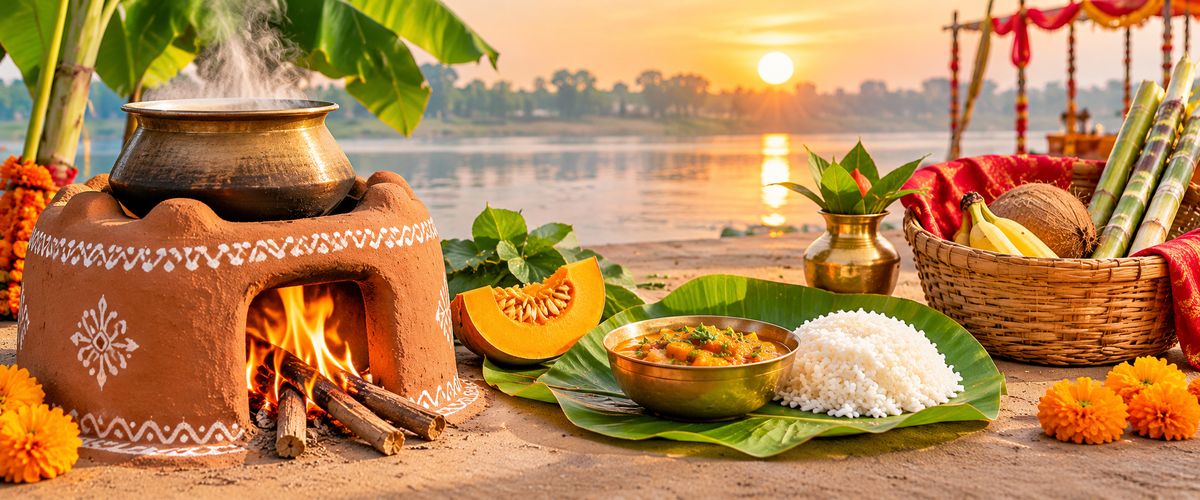
Nahay Khay in the Chhath 2026 calendar
- Nahay Khay: Friday, 13 November (Kartik Shukla Chaturthi)
- Kharna: Saturday, 14 November
- Sandhya Arghya: Sunday, 15 November
- Usha Arghya and parana: Monday, 16 November
The name says what the day is: nahay, bathe, and khay, eat. The vrati bathes, takes the sankalp for the fast, and eats one plain meal cooked with unusual care. Nothing about it looks dramatic beside the 36-hour waterless fast that follows, but this is the day the household changes over. The house has been cleaned, onion and garlic leave the kitchen, and from here until the final arghya everything is done with the purity rules in mind.
Chhath has no single rulebook. It is carried from mother-in-law to daughter-in-law, and customs change from one district to the next. This guide brings together what Hindi newspapers, festival guides and the people who build chulhas describe. Where they agree, it says so. Where they differ, it gives you the options. If your family has its own way, your family's way comes first.
What to finish before Nahay Khay
- Clean the whole house, with most attention on the kitchen, the puja corner and the place where prasad will be cooked. In villages the courtyard is freshly plastered with mud and cow dung.
- Set up the place for prasad. Choose a spot where everyday cooking does not happen, and keep it away from used dishes.
- Get the chulha ready (the method is below) and stack the mango wood somewhere dry.
- Sort the vessels. Use new or thoroughly scrubbed ones. Brass, copper and clay are the traditional choices. Plastic, aluminium and anything used for cooking meat are treated as impure, and some families also rule out steel and glass.
- Stop onion, garlic, meat, fish and alcohol in the house. Many Chhath families go vegetarian from the start of Kartik, well before the festival.
- Buy for the meal: lauki, chana dal, arwa rice, sendha namak and pure ghee.
- Keep the vrati's clothes washed and ready, along with a mat for sleeping on the floor. Our Chhath samagri list covers everything needed for the later days.
- Bring wheat for thekua home early if you wash and grind your own, because it needs clear sun to dry. The thekua guide explains how it is handled.
Nahay Khay vidhi: the order of the day
- Wake before sunrise.
- Bathe, in the Ganga or another river or pond if you can reach one safely. At home, add Gangajal to the bathing water. Some families bring river water back and sprinkle it through the house.
- Put on clean clothes. Many women wear a yellow or orange saree. Black is avoided.
- Take the sankalp. The vrati makes a quiet resolve to keep the fast with a clean mind, speech and conduct, and offers a prayer to Surya Dev and Chhathi Maiya.
- Cook the meal after bathing, without tasting it while it cooks. The vrati cooks it or at least helps.
- Offer it first to Surya Dev and Chhathi Maiya.
- The vrati eats first, and the rest of the family eats afterwards, receiving the meal as prasad.
- The vrati does not eat again that day. At night they sleep on a mat on the floor, not on a bed.
The meal: lauki, chana dal and arwa rice
The dish is called kaddu-bhat, and the name causes confusion outside Bihar. In this context kaddu means lauki (bottle gourd, ghiya), not the yellow pumpkin that the word means in much of north India. English articles often translate it as "pumpkin", which is where the mix-up starts.
| Item | What to use | Why, or what varies |
|---|---|---|
| Rice | Arwa (unparboiled) rice | Plain steamed. Arwa is the rice treated as ritually pure, unlike usna (parboiled) rice. |
| Dal | Chana dal | Regarded as the purest of the dals. Some homes cook it together with the lauki. |
| Vegetable | Lauki | It holds a great deal of water, which is the practical reason given for eating it before the long fast. |
| Salt | Sendha namak | Rock salt rather than table salt. |
| Fat | Pure ghee | Some families use mustard oil. Follow your own custom. |
| Spices | Very few | No onion or garlic and no packaged masala. |
To cook it, wash everything in clean water. Boil the soaked chana dal until soft and season it lightly with sendha namak. Peel and cube the lauki and cook it gently in ghee until tender. It needs little more than salt, since it is meant to taste clean. Steam the rice separately and serve all three together, freshly made. Fried food is avoided, and nothing is kept back to reheat later.
The rules most families share
| Do | Avoid |
|---|---|
| Eat one sattvik meal after the bath | Eating again later in the day |
| Let the vrati eat before the family | Serving anyone before the offering is made |
| Keep the whole household sattvik | Onion, garlic, meat, fish, alcohol or tobacco in the home |
| Wash hands before touching prasad or its vessels | Touching prasad with used hands, or letting it be tasted |
| Sleep on a mat on the floor | Sleeping on a bed |
| Wear clean clothes, unstitched if your custom asks for it | Black clothing, and for strict families stitched clothes or a saree with a sewn fall |
| Speak gently through the four days | Lying, quarrelling or harsh words |
Why a new clay chulha
A stove that has already cooked ordinary food is not used for Chhath prasad, so the chulha is made new and kept for this purpose alone. Last year's is not brought back into use. The Kharna kheer and roti and the thekua are cooked on it. Many families cook the Nahay Khay meal on it too, while others make that meal in a thoroughly cleaned kitchen and keep the new chulha for prasad from Kharna onward.
The people who make these stoves take the purity seriously as well. Potters in Ranchi's Harmu area and makers in Jamshedpur bathe before they start and keep off meat and fish while the work lasts. In Patna, Muslim women have made Chhath chulhas for around three decades. They also keep to vegetarian food during the month of work, and keep the stoves away from used dishes.
How to make a clay chulha at home
You will need: clean soil, cow dung, chopped straw (puaal or kutti) or husk (bhoosi), and clean water. Makers use soil from the village or from a riverbank or pond edge, and in Patna some Ganga-bank soil is added. The straw and husk bind the mix and help it resist cracking.
- Bathe first and work in clean clothes, as the makers do.
- Choose the spot. A wet chulha is heavy and fragile, so build it where it can stay until it dries, or on a board you can lift. It needs sun and moving air, away from used dishes and from where people walk.
- Clean the soil. Take it from a clean place, never near a drain or rubbish, and pick out stones and roots.
- Mix. Soil makes up most of the mix, with smaller amounts of dung and straw. Add water a little at a time and knead with your hands until it holds its shape without sticking. There is no fixed ratio. Makers go by feel, so roll a small ball first and see whether it cracks as it dries.
- Shape it by hand. Build a thick horseshoe-shaped wall, open at the front where the wood goes in. Raise three points along the top for the vessel to rest on.
- Test the fit while it is soft. Set your largest kadhai or pot on the three points. It should sit steady, with gaps left for flame and smoke to escape.
- Smooth the surface with wet hands and finish with a thin coat of soil and dung mixed with water.
- Dry it slowly and fully. Give it sun by day, and bring it under cover from dew or rain. Fill fine surface cracks with the same mix. If a crack runs through the wall, rebuild that part.
- Plaster it (lipai) with a fresh coat of soil and dung before use. A proper Chhath chulha is one that can be plastered again each day.
How long does it take to dry?
It depends on the size of the chulha and the weather, and this is where most home-built ones go wrong. Workshops start one to three months ahead, because a large chulha dried too quickly or incompletely can break in use. Households in Bihar and Uttar Pradesh do build smaller ones in the days before the festival, and rely on strong sun to finish them. A dry chulha is even and pale in colour, hard to the touch, and has no cool, damp feel underneath. If it still feels damp on Kharna, do not light it.
If your chulha will not be ready, or you live in a flat
- Buy one. Ready-dried chulhas are sold in Chhath markets. Recent prices have been roughly ₹100 to ₹200, depending on size. A large one can cook about 15 to 25 kg of prasad.
- Use three bricks. Wash three bricks well, coat them with cow dung, let them dry, and stand them as a stove.
- Use a new gas stove. Where a wood fire is not possible, the accepted alternative is a new stove that comes out only for Chhath each year, not the one used for daily cooking.
Safety: never burn wood in a closed room, because the smoke and carbon monoxide are dangerous. Use an open terrace or courtyard, check your housing society's rules, and keep water close by. On the first day of use, start with a small fire and build it up gradually, since sudden heat can crack new clay.
Mango wood, and only mango wood
The fuel for prasad is traditionally mango wood. It is regarded as pure and sattvik, and it is the same tree whose leaves hang in the toran at auspicious ceremonies. Many families will not use any other wood for prasad, so buy it in advance and keep it dry, because damp wood smokes heavily. Keep it apart from fuel used for everyday cooking.
Frequently asked questions
When is Nahay Khay in 2026?
Friday, 13 November 2026, which is Kartik Shukla Chaturthi. Kharna follows on 14 November.
Can the vrati drink water on Nahay Khay?
Yes. Nahay Khay is a single-meal day, not a waterless one. The 36-hour nirjala fast begins only after the Kharna prasad on the following evening.
Can I use yellow pumpkin instead of lauki?
The traditional vegetable is lauki, and that is what "kaddu" means in this meal. It is sold nearly everywhere, so look for lauki first. If you truly cannot find it, ask the elder whose Chhath tradition you follow.
Is the Nahay Khay meal cooked on the clay chulha?
In many homes, yes, with mango wood. Others cook it in a well-cleaned kitchen. The new-chulha rule is firmest for prasad made from Kharna onward.
Can last year's chulha be used again?
The usual answer is no. Prasad is made on a new chulha, and one that has already been used for cooking is not reused.
Can other family members eat the same meal?
Yes, and they usually do. They eat after the offering and after the vrati, and the whole household keeps to sattvik food.
Why is rock salt used?
Sendha namak is the salt used for fasting food in Hindu practice because it is treated as pure and unprocessed. Note that the prasad from Kharna onward, including the kheer and thekua, is made without salt.
Can a person who has never kept Chhath start this year?
Yes, though it helps to have someone experienced guide you. Traditionally a vrati who begins continues in the following years, or hands the vrat on to someone in the family, so talk it over with your elders before you take the sankalp.
Was this article helpful?
Spotted a mistake?
If you find any grammatical, Hindi, English, mantra-text or other mistake on this page, tell us — we will correct it within 24 hours.