
Shri Surya Dev
The sun god, source of all light and life, worshipped each sunrise as the eye of the cosmos.

Who Surya is
Surya is the Sun god, one of the most ancient deities in the Vedic tradition. Hymns to him appear throughout the Rigveda, which makes him older than most of the named gods worshipped in Hindu practice today. Unlike most deities, he is also directly visible: every sunrise is his darshan. He is worshipped daily at dawn across India, most visibly through Surya Namaskar (sun salutation) and the offering of water (arghya) facing the rising sun. He is the source of light, warmth, health and time itself, and he is the first of the Navagraha.
In scripture
The Gayatri Mantra, the most sacred verse of the Vedas, is addressed to Savitr, the Sun as the power that brings things to life. In the Ramayana, the sage Agastya teaches Ram the Aditya Hridaya Stotra on the battlefield before his final fight with Ravana, a hymn still recited for strength and victory. The Samba Purana and Bhavishya Purana describe Sun worship at length.
Parentage and family
Surya is usually described as the son of the sage Kashyapa and Aditi, which makes him one of the Adityas. He is the father of several major figures: Karna (by Kunti) in the Mahabharata, and Yama, Yamuna, Shani (Saturn) and the Ashwini Kumaras by his wife Sanjna and her shadow-form Chhaya. His son Shani is worshipped very differently from him (see Shani Dev): Surya stands for brilliant, life-giving energy, Shani for slow, disciplined justice. Hanuman is also said to have learned the scriptures from Surya, keeping pace with him across the sky.
Iconography and the seven horses
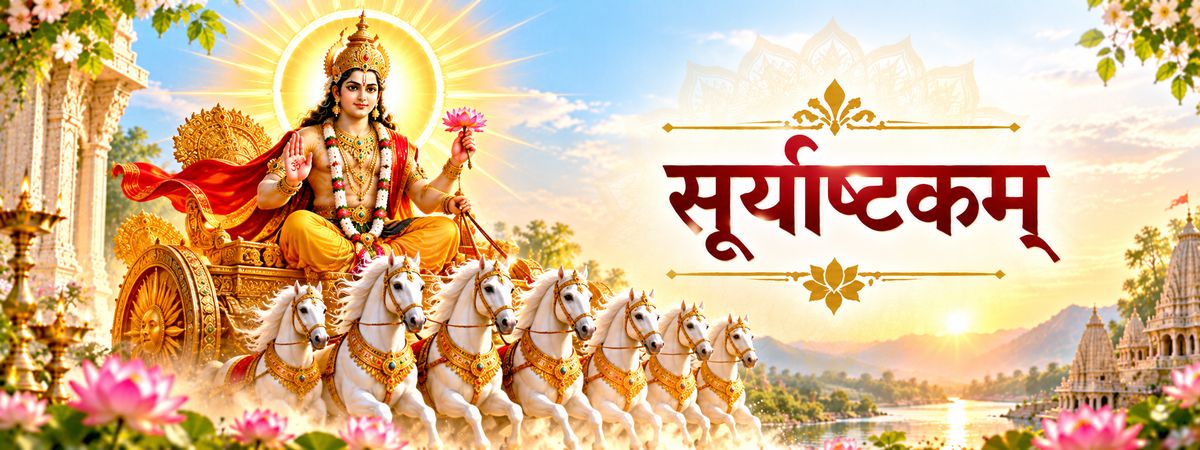
Surya is traditionally shown riding a chariot pulled by seven horses, said to stand for the seven colours of light or the seven days of the week. It is driven by Aruna, his charioteer, who has no legs, a detail meant to show that the sun's chariot needs no physical support to move across the sky. He holds lotus flowers in both hands and radiates light from behind like a halo.
How he is worshipped
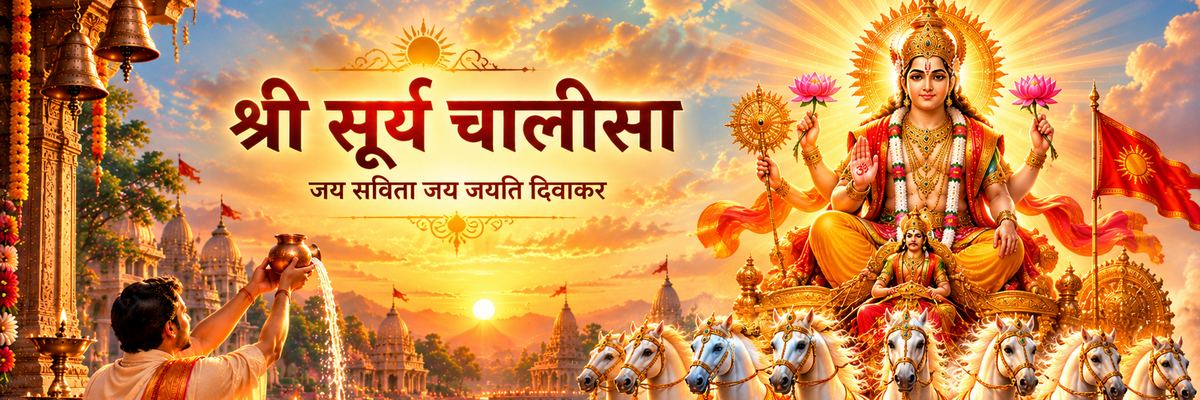
The core practice is arghya at sunrise: after bathing, stand facing the rising sun and pour water from a copper pot (lota), often with red flowers, rice and a little kumkum, so that the sun is seen through the stream of water, while chanting his names or the Surya Gayatri Mantra. His day is Sunday (see Sunday Surya Bhakti), when some keep a salt-free fast. The twelve rounds of Surya Namaskar are traditionally done with his twelve names, and the Surya Chalisa and the aarti Om Jai Surya Bhagwan are sung at home.
Festivals and temples
Makar Sankranti (Pongal in Tamil Nadu), usually on 14 January, marks the Sun's entry into Capricorn and the start of his northward journey (uttarayan). It is one of the few Hindu festivals fixed to the solar calendar. Ratha Saptami, in the bright fortnight of Magh, is his birthday. Chhath Puja, a major festival in Bihar and eastern Uttar Pradesh six days after Diwali, is dedicated almost entirely to Surya and Chhathi Maiya: devotees stand in water to offer arghya to the setting and the rising sun. His great temples include the 13th-century Konark Sun Temple in Odisha, built as his giant stone chariot with carved wheels, the Modhera Sun Temple in Gujarat, the ruins of Martand in Kashmir, and Suryanar Kovil in Tamil Nadu.
Jalabhishek
Daily Bhakti
Mantra
Aditya Hridaya Stotra
The hymn to the Sun that sage Agastya taught Shri Ram before his final battle with Ravana — 31 verses from the Valmiki Ramayana, recited for courage, clarity and victory over obstacles.
Read more →MantraSurya Gayatri Mantra
A Gayatri-pattern mantra invoking Surya as Aditya, source of light and illumination.
Read more →MantraOm Ghrini Suryaya Namah (Surya Mantra)
The short Surya mantra chanted while offering water to the rising sun. What "ghrini" means, the other Surya mantras it is often paired with, and how to combine it with Sunday arghya.
Read more →Stotra
Chalisa
Aarti

Article

Festival
Story

Vrat
Puja Vidhi
Spotted a mistake?
If you find any grammatical, Hindi, English, mantra-text or other mistake on this page, tell us — we will correct it within 24 hours.