
Maa Ganga
The river who is a goddess: brought down from heaven by Bhagiratha, caught in Shiva's matted hair, and worshipped every evening on the ghats of Haridwar and Varanasi.
A river and a mother
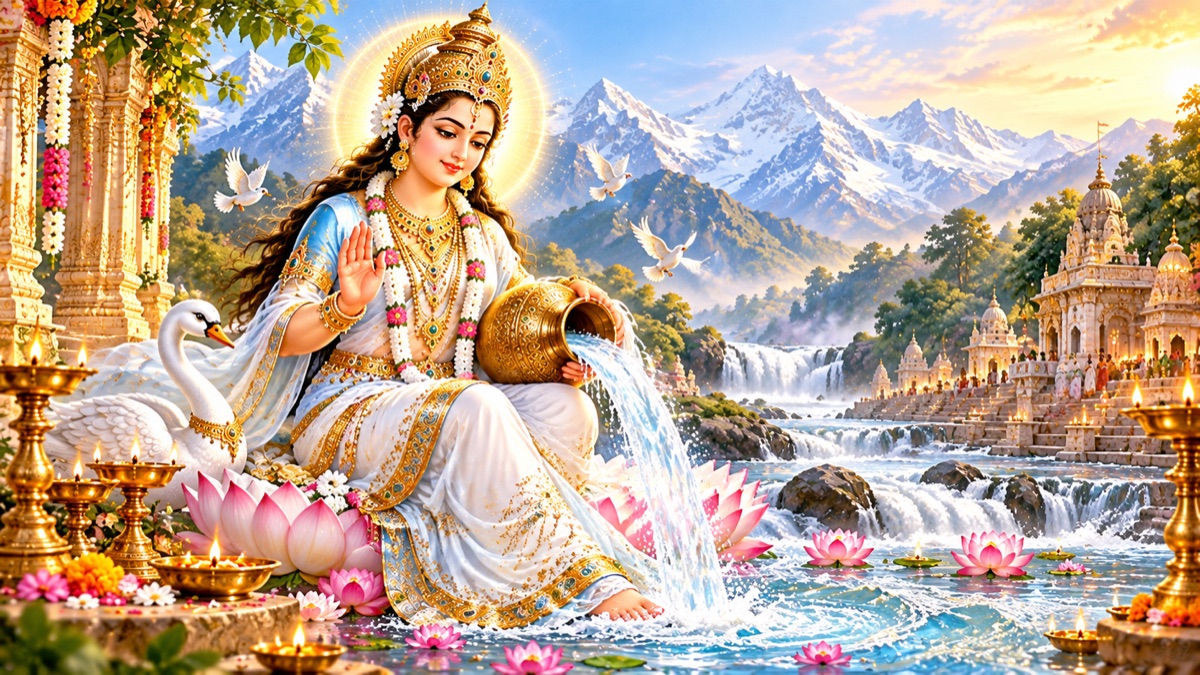
For Hindus the Ganga is not a river that happens to be sacred; she is a goddess who happens to be a river. She is called Ganga Maiya, Mother Ganga, and her water, Gangajal, is kept sealed in almost every Hindu home, sprinkled to purify a room, poured into the mouth of the dying, and carried home from pilgrimages. Her icon shows a fair goddess holding a water pot and a lotus, riding the makara, a crocodile-like river creature.
How she came down: Bhagiratha's penance
The Ramayana (Bala Kanda) and the Puranas tell the story of her descent, the Gangavataran. King Sagara's sixty thousand sons, searching for their father's sacrificial horse, found it near the sage Kapila and accused him of theft; his gaze burned them to ash. Only the waters of heaven could free their souls. Generations later, Sagara's descendant Bhagiratha did tapasya until Ganga agreed to come down. But the force of her fall would have shattered the earth, so Bhagiratha prayed to Shiva, who caught her in his matted hair and released her in gentle streams. That is why Shiva is Gangadhar, and why the river at her source is still called the Bhagirathi. On the way the sage Jahnu, whose ashram she flooded, drank her up and released her from his ear, which gives her the name Jahnavi. Finally she reached the ashes of Sagara's sons and gave them liberation. This is the origin of the belief that ashes immersed in the Ganga bring moksha.
Her other names and stories
- Vishnupadi: in Vaishnava tradition she flows from the foot of Vishnu as Vamana, when his step pierced the shell of the universe.
- Bhishma's mother: in the Mahabharata she marries King Shantanu and is the mother of Bhishma, who is called Gangaputra.
- Tripathaga: she flows in three worlds, heaven, earth and the underworld.
Source to sea
Geographically, the Bhagirathi rises at Gaumukh below the Gangotri glacier, and at Devprayag it meets the Alaknanda; from there the joined river is called the Ganga. She flows past Rishikesh, Haridwar, Prayagraj, where she meets the Yamuna and the unseen Saraswati at the Triveni Sangam, Varanasi and Patna, and reaches the sea at Gangasagar, where Kapila's ashram is said to stand. Two of the four Kumbh Mela sites, Haridwar and Prayagraj, stand on her banks.
Ganga Dussehra and Ganga Saptami
Ganga Dussehra, Jyeshtha Shukla Dashami, celebrates her descent to earth; bathing that day is said to wash away ten kinds of sin, which is how it gets its name. Ganga Saptami, Vaishakha Shukla Saptami, marks her rebirth from Jahnu's ear. Every evening the Ganga Aarti at Har Ki Pauri in Haridwar and Dashashwamedh Ghat in Varanasi draws thousands, with great multi-tiered lamps waved over the water. At home, devotees sing Om Jai Gange Mata and the Ganga Chalisa.
A goddess who needs protecting
It is impossible to speak honestly of Ganga today without saying that the river is under strain from sewage, industry and dams. Many devotees now see protecting her as part of her worship: offering flowers without plastic, not immersing idols painted with chemical colours, and keeping the ghats clean. A mother who has carried so much is owed that care.
Mantra
Stotra
Chalisa
Aarti
Puja Vidhi
Spotted a mistake?
If you find any grammatical, Hindi, English, mantra-text or other mistake on this page, tell us — we will correct it within 24 hours.