
Santoshi Mata
The goddess of contentment, Ganesha's daughter, worshipped with jaggery and roasted chickpeas in the sixteen-Friday vrat.
Who Santoshi Mata is
Santoshi Mata is the goddess of santosh, contentment. Her name is her whole teaching: the peace that comes from having enough rather than wanting more. She is a young goddess in the historical sense. Her worship spread through north and west India in the twentieth century, mostly among women and through a simple Friday vrat, and it grew enormously after the 1975 Hindi film Jai Santoshi Maa. You will not find her in the older Puranas, but that has not stopped her from becoming one of the most widely worshipped household goddesses in India.
Ganesha's daughter
Tradition makes her the daughter of Ganesha and his consorts Riddhi and Siddhi, and the Santoshi Mata Chalisa calls her exactly that: Ganesh ki suta. The popular story, told in the vrat katha and the film, is set on Raksha Bandhan. Ganesha's sons Shubh and Labh are upset that they have no sister to tie a rakhi on their wrists. Moved by their wish, and urged on by Narada and the women of the household, Ganesha brings forth a daughter from a divine flame. She is named Santoshi because she brings contentment to the family. The story is less about cosmic battles than about family warmth, which suits a goddess worshipped mostly at home.
How she is pictured
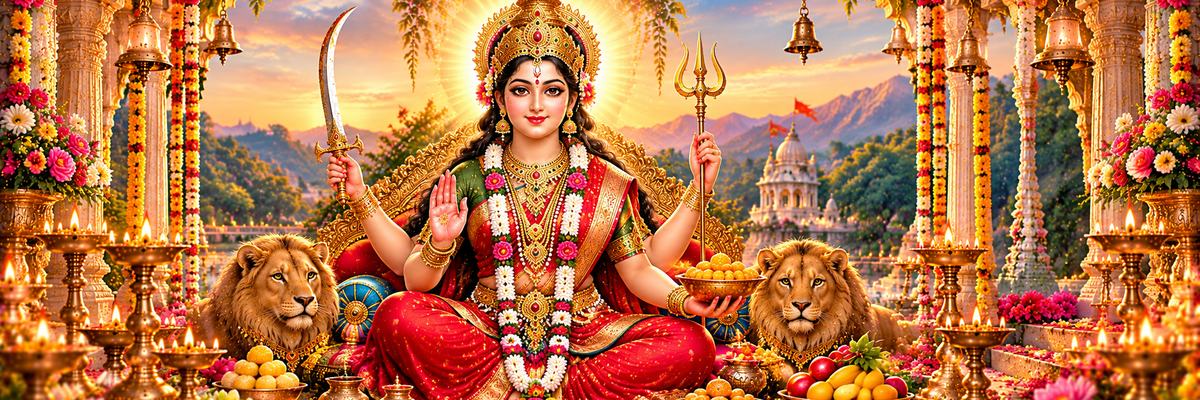
Her image is calm rather than fierce. She is shown seated on a lotus, four-armed, holding a sword, a trident and a bowl of rice, with her fourth hand raised in blessing. The chalisa describes her dressed in white with wide eyes, while the aarti "Jai Santoshi Mata" pictures her in a golden robe with a lotus face and a gentle smile. Unlike many goddesses she has no particular mount; it is the plain offering of jaggery and chickpeas that marks her worship.
The sixteen-Friday vrat
Friday is her day, and the Santoshi Mata vrat is the centre of her worship. Its order is simple:
- Bathe in the morning and set up her picture or a kalash.
- Offer jaggery and roasted chickpeas (gud-chana), a lamp and flowers.
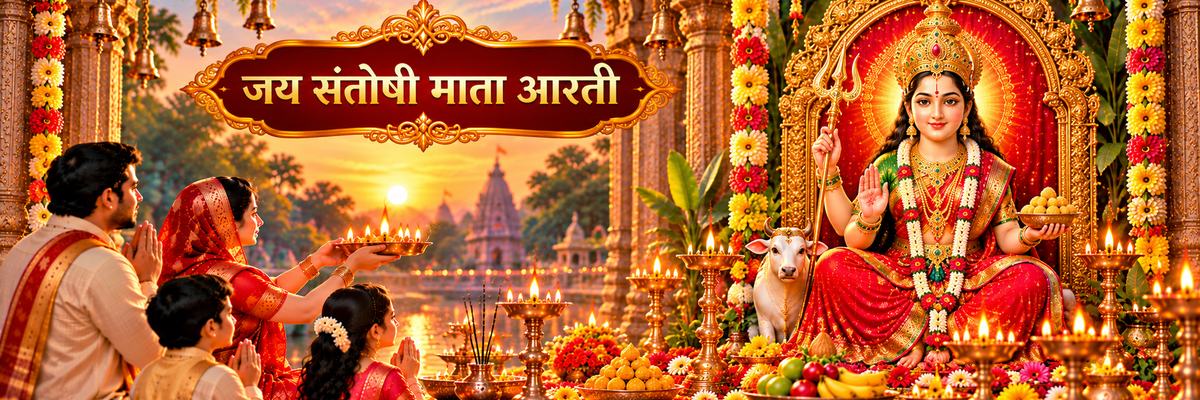
- Read or listen to the vrat katha, then the chalisa, and end with the aarti.
- Share the jaggery and chickpeas as prasad, and eat one simple meal.
The one firm rule is that nothing sour (khatai) is eaten, cooked or served that day: no curd, lemon, tamarind, pickle or sour fruit. Most people keep the vrat for sixteen Fridays and then complete it with an udyapan, feeding eight boys a meal with nothing sour in it and giving them a small gift rather than cash. The aarti explains why the offering is so humble: jaggery and chickpeas are what pleased her, and in them she found contentment.
The vrat katha in brief
The katha tells of a poor daughter-in-law whose husband leaves home to earn a living and is not heard from. Mistreated by her in-laws, she learns of the Friday vrat, keeps it faithfully, and her husband returns with wealth. At her udyapan, jealous relatives coax the boys into asking for something sour, she gives in, and trouble returns until she keeps the vrat again with care. The story's moral is the vrat's whole spirit: faith, patience, and keeping a simple promise exactly.
Where she is worshipped
Small Santoshi Mata shrines are found across north India, often inside larger temple complexes, and one of the best known is the temple at Lal Sagar near Jodhpur in Rajasthan, which draws large crowds on Fridays. Her chalisa goes further and claims the great Devi shrines as her own: Vindhyavasini, Kali of Kolkata, Jwala Devi, Mahalakshmi of Mumbai, Meenakshi and others are all, it says, Santoshi Mata herself. It is a way of saying that the goddess of contentment is the same Mother people have always known.
Mantra
Chalisa
Aarti
Puja Vidhi
Spotted a mistake?
If you find any grammatical, Hindi, English, mantra-text or other mistake on this page, tell us — we will correct it within 24 hours.