
Kuber Dev
King of the Yakshas, treasurer of the gods and guardian of the north, worshipped beside Lakshmi on Dhanteras and Diwali for wealth that stays.
The keeper, not the giver
Kuber is often called the god of wealth, but the older idea is more precise: he is wealth's keeper. Lakshmi is the goddess who brings prosperity; Kuber is the treasurer who guards it, counts it and hands it out. That is why the two are worshipped together on Dhanteras and Diwali. People pray to Lakshmi that money should come, and to Kuber that it should stay and be used well. He is king of the Yakshas, the semi-divine guardians of the earth's hidden treasures, and he holds the nava nidhi, the nine treasures, among them Padma, Mahapadma, Shankha, Makara and Kachchhapa.
Ravana's elder half-brother
The Ramayana and the Puranas make him the son of the sage Vishrava and Ilavida, which is why he is also called Vaishravana, "son of Vishrava". Ravana, Kumbhakarna and Vibhishana were Vishrava's sons by another wife, Kaikasi, so Kuber is Ravana's half-brother. After long tapasya, Brahma made him lord of wealth and one of the lokapalas, the guardians of the directions, and gave him the flying chariot Pushpaka. He first ruled from golden Lanka. Ravana drove him out and seized both Lanka and Pushpaka; the same Pushpaka later carried Rama back to Ayodhya. Kuber then built his city of Alaka in the Himalaya near Kailash and became a close friend and devotee of Shiva. The aarti Om Jai Yaksha Kuber Hare remembers this when it calls him the greatest devotee among Shiva's devotees.
How he is pictured
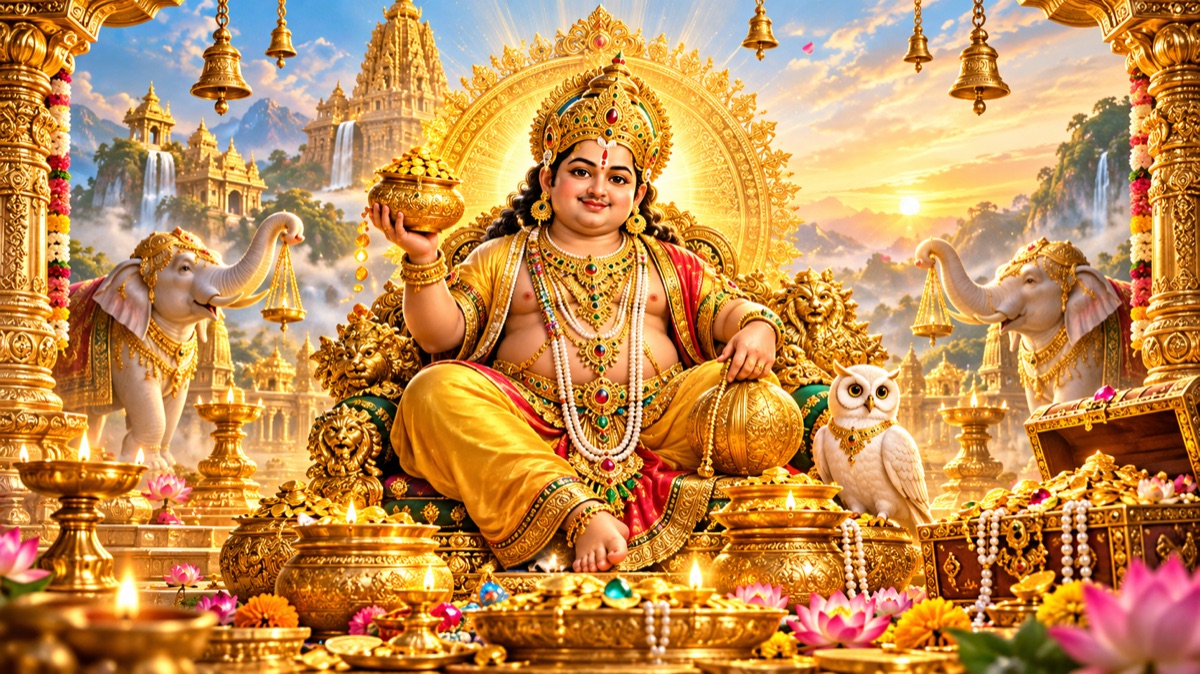
He is short and pot-bellied, richly dressed and covered in jewels, usually seated, with a money pot or a bag of coins in his hand. Some images give him a club, and many, especially in Buddhist and Himalayan art where he is Jambhala or Vaishravana, show a mongoose that spits jewels from its mouth. His body is described as imperfect in the Puranas: three legs, eight teeth, one eye yellowed. The point of the image is not beauty. It says that wealth does not need to look grand to be real.
His sons and Krishna
Kuber's sons Nalakuvara and Manigriva are part of one of the best-loved Krishna stories. Drunk and careless, they were cursed by Narada to stand as two arjuna trees in Gokul until Krishna came. Years later the child Krishna, tied by Yashoda to a mortar (ulukhal), dragged it between those two trees, pulled them down and freed the brothers. This is the Damodar lila sung in the Damodarashtakam.
Tirupati and the loan
In South India the most famous Kuber story belongs to Tirumala. The legend says that Lord Venkateswara borrowed a vast sum from Kuber to pay for his marriage to Padmavati, and that devotees' offerings in the temple hundi are still helping him pay back the interest. It turns every gift at Tirupati into a share in the Lord's debt.
When and how he is worshipped
His great day is Dhanteras, Kartik Krishna Trayodashi, when Kuber is worshipped with Lakshmi, Ganesh and Dhanvantari, and again on Diwali night. Because he guards the north, many households keep their safe or cash box facing north and put his image or a Kuber yantra there. A simple puja needs only a lamp, yellow or white flowers, rice, a few coins and the Kuber mantra, followed by the Kuber Chalisa and his aarti. The traditional teaching around him is sober: Kuber blesses wealth that is earned honestly and shared, and the Puranas tell of his own pride being humbled, so he is a reminder that money is something one guards for others, not just for oneself.
Mantra
Chalisa
Aarti
Puja Vidhi
Spotted a mistake?
If you find any grammatical, Hindi, English, mantra-text or other mistake on this page, tell us — we will correct it within 24 hours.