
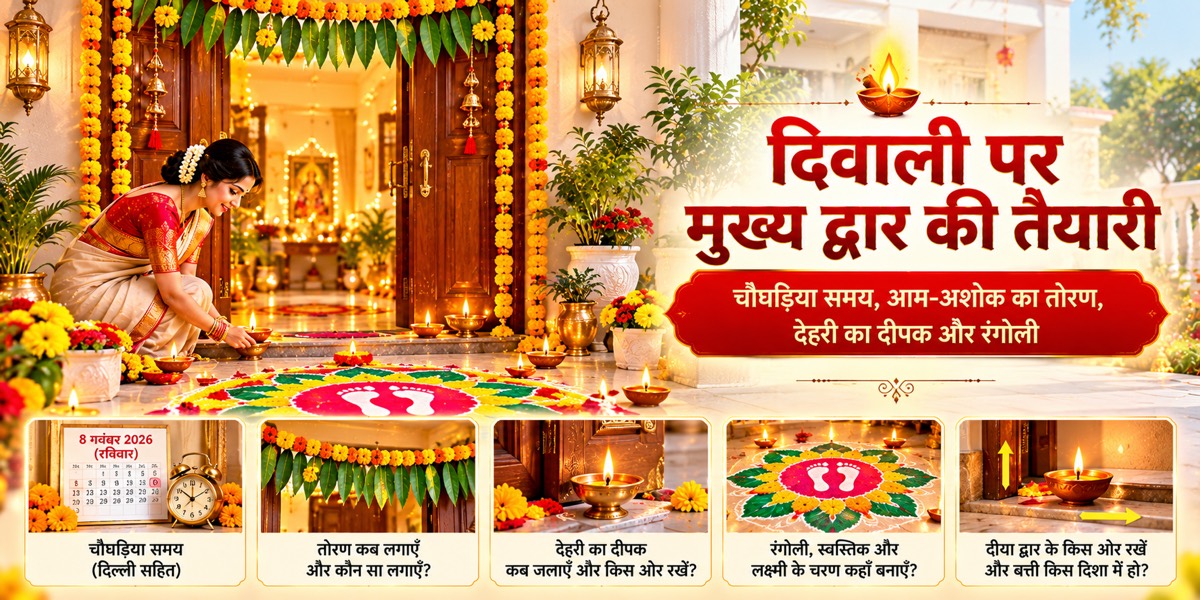
Why the main door gets its own rituals
In the Hindu home the main door is not just an entrance. It is where guests are received with water and where the bride enters with her foot on a kalash of rice; it is where the evening lamp is shown to the street; and on Diwali it is the way Lakshmi is believed to come in. The threshold (dehri) is treated as a boundary: what is inside is to be protected, and what is outside is to be kept outside. Everything families do at the door on Diwali, the toran, the lamp, the rangoli, the footprints, works on those two ideas at once: welcome and protection.
When: Diwali 2026 timings for the door
Diwali's Lakshmi Puja is on Sunday, 8 November 2026. In Delhi:
- Lakshmi Puja muhurat: 5:54 pm to 7:50 pm (Pradosh kaal with Vrishabha lagna)
- Pradosh kaal: 5:31 pm to 8:09 pm
- Amavasya tithi: 11:27 am on 8 November to 12:31 pm on 9 November
The door is prepared during the day and its lamp is lit at dusk. Families who like to time the toran and the rangoli use the day's choghadiya. In Delhi on 8 November:
- Morning (Char, Labh, Amrit): 11:27 am to 12:05 pm
- Afternoon (Shubh): 1:26 pm to 2:48 pm
- Evening (Shubh, Amrit, Char): 5:31 pm to 10:27 pm
A practical order: put up the fresh toran in the morning or afternoon window, finish the rangoli by late afternoon so it is dry, and light the threshold lamp at the start of Pradosh kaal, before or along with the puja. Timings for other cities are in our Diwali 2026 Lakshmi Puja article, and how choghadiya works is explained in our choghadiya guide.
The threshold lamp: which side, which way
Placement
Stand in the doorway facing out, towards the street. The lamp goes on your right-hand side, just outside the threshold. This is the same rule used for the Yama Deepam on Dhanteras night. Many families light a pair, one on each side, and in that case the right-hand lamp is lit first. Put it on a small plate or a few grains of rice rather than directly on the floor, so oil does not stain the step and the base sits steady.
The wick and the flame
Use a clay diya with mustard oil and a long wick (lambi bati) resting on the spout. Turn the spout so the flame points outward, towards the street or the corridor. The lamp at the door is a lamp of welcome to those who come and of protection against what should not come in; families describe the outward-facing flame as a guard at the gate. The one exception is the Yama Deepam on Dhanteras, whose flame faces south wherever the door faces.
Flats and shared corridors
In an apartment the corridor is the "street". Keep the diya on a steel plate, well away from the doormat, shoe racks and the neighbours' door, and never leave it burning unattended in a corridor with curtains or paper decorations. An enclosed brass lamp (a lantern-style deepak) is a sensible choice here.
The toran: mango, ashoka, marigold or plastic?
Mango leaves
Mango (aam) leaves are the classic toran for every auspicious occasion, from griha pravesh to weddings. The tree is associated with fertility and with Kamadeva, and mango leaves are the ones placed on the mouth of the kalash. Tie them on a string, stem upward, leaves hanging down, in an odd number (5, 7, 11 or 21) across the top of the door frame.
Ashoka leaves
Ashoka (Saraca asoca, the true ashoka, not the tall false ashoka planted along roads) means "without sorrow", and its leaves are hung for the same reason. Many families mix mango and ashoka leaves, or alternate them with marigold flowers, whose saffron colour is itself auspicious.
Plastic or synthetic torans
A fresh toran's point is that it is alive: it wilts in a few days, and replacing it is part of the cycle of cleaning and renewal. A plastic toran never wilts, which is exactly why it can hang for a year collecting dust. There is no harm in using a decorative fabric or beaded toran, which many homes keep all year; but on Diwali, tie a string of real leaves along with it, and take the leaves down once they have dried, by Bhai Dooj or a few days after. A dry, brown toran left up is considered a poor sign.
| Toran | Lasts | Notes |
|---|---|---|
| Mango leaves | 3–5 days | The traditional choice; odd number, tied stem-up |
| Ashoka leaves | 4–6 days | "Without sorrow"; often mixed with mango |
| Marigold | 2–4 days | Colour and fragrance; compost when dry |
| Fabric, beads, metal | Years | Fine as decoration; dust it and add fresh leaves for Diwali |
| Plastic leaves or flowers | Years | Least preferred; does not replace a fresh toran |
Rangoli, swastik and Lakshmi's footprints
- Rangoli goes on the ground just outside the threshold, or in the entrance area of a flat. Draw it after the last mopping, while the floor is dry. A lamp is usually set in its centre or at its edge.
- Swastik and Shubh-Labh. Draw a swastik in roli or sindoor on the door, or on either side of it, and write Shubh on the left and Labh on the right (as you face the door from outside). These are Ganesh's sons in popular tradition, and the pair is Ganesh's mark of auspicious beginnings.
- Lakshmi's footprints (charan). Draw them with rice paste (aipan or alpana) or use stickers, pointing inward: they start at the threshold and walk towards the mandir or the safe. Footprints pointing out of the house are a mistake to avoid. A small pair is enough; there is no need to put them in every room.
- Keep the threshold clear. Move shoes, dustbins and broken pots away from the door. Nothing should block the way in.
Small things families do at the door
- Wash the threshold with water, and in many homes a little turmeric water or Ganga jal, on Diwali morning.
- Keep the door open, or ajar, during the Lakshmi Puja.
- Don't sit on the threshold, and don't hand anything to someone across it.
- Many traders keep a lamp at the shop shutter as well as at home, lit in the evening choghadiya.
Frequently asked questions
On which side of the main door should the Diwali diya be placed?
On your right as you stand in the doorway facing out, just outside the threshold. If you light two, light the right-hand one first.
Which direction should the flame of the door diya face?
Outward, towards the street or corridor. The exception is the Yama Deepam on Dhanteras (6 November 2026), which faces south.
When should I put up the toran in 2026?
On Diwali day, 8 November, ideally in a good choghadiya: in Delhi, 11:27 am to 12:05 pm or 1:26 to 2:48 pm. Many families put up the first one on Dhanteras and refresh it on Diwali.
Are plastic torans inauspicious?
Not inauspicious, but they don't replace a fresh toran of mango or ashoka leaves. Keep the decorative one if you like and add real leaves for Diwali.
Which way should Lakshmi's footprints point?
Inward, from the threshold towards the mandir or the safe, as though she is walking into the house.
When should the dried toran be removed?
Once the leaves dry, usually within the five days of Diwali, by Bhai Dooj on 11 November. Don't throw it in the bin: compost it or put it under a tree.
Where do Shubh and Labh go?
Shubh on the left and Labh on the right, as you face the door from outside, with a swastik between or above them.
Was this article helpful?
Spotted a mistake?
If you find any grammatical, Hindi, English, mantra-text or other mistake on this page, tell us — we will correct it within 24 hours.
Related content
- Maa Lakshmi
- Diwali 2026 Laxmi Puja Vidhi: A Step-by-Step Guide to Welcoming Mahalakshmi at Home and at Your Shop or OfficePublished10 min read
- What to Buy and Avoid on Dhanteras 2026? Zodiac-wise Shopping, 3 Coriander Remedies and Yama DeepamPublished10 min read
- Choghadiya: Reading the Day's Good and Bad Hours
- Maa Lakshmi Puja Vidhi: Friday Worship and Diwali Night
- Diwali (Deepavali)