
From one evening lamp to a house full of light
Most Hindu homes already light at least one lamp every evening at sandhya, the moment the sun goes down. Diwali does not invent a new ritual; it multiplies the one you already do. The same rules about wicks, oils and direction that govern the daily lamp simply extend outward, from the mandir to the Tulsi, to the doorway, and then to every room, window and rooftop. If you get the daily lamp right, the Diwali lamps follow naturally.
In 2026 the lamp-lighting evenings are Friday 6 November (Dhanteras and Yama Deepam), Saturday 7 November (Chhoti Diwali, Narak Chaturdashi evening) and Sunday 8 November (Diwali Lakshmi Puja, Pradosh kaal 5:31 to 8:09 pm in Delhi).
Two kinds of lamp, two kinds of wick
The round brass lamp and the gol bati
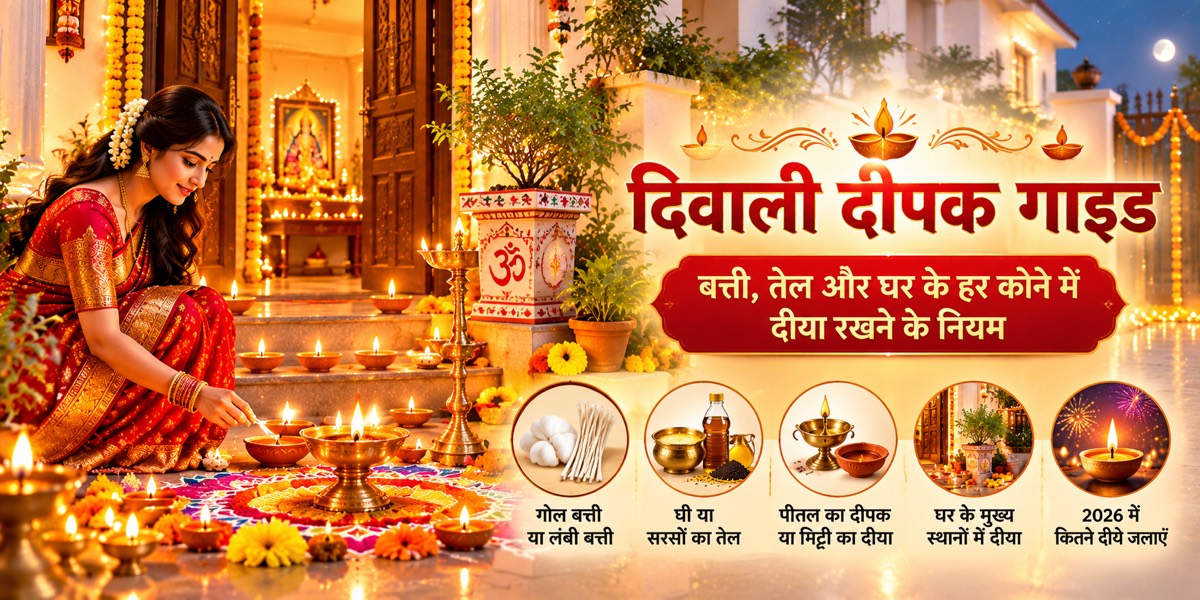
The lamp in the mandir is usually a round brass or silver diya or a samai with a shallow, cup-like bowl. It takes a gol bati (also called phool bati): a little cotton tuft rolled into a round base with a pointed tip that stands upright in the middle of the bowl. The flame rises straight up, burns steadily in ghee, and does not need to rest on a rim. This is the wick used for the daily lamp and for aarti.
The beaked clay diya and the lambi bati
The clay diya has a pinched spout (the "beak" or "face"). It takes a lambi bati, a long wick rolled between the palms, which lies in the oil and rests its tip on the spout. The flame burns at the spout, pointing in a definite direction, which is why direction matters for clay diyas and much less for round lamps. A round wick placed loose in a beaked diya tips over; a long wick in a round brass lamp floats and smokes. Match the wick to the lamp.
Cotton, kalava and the number of wicks
- Cotton is the default for both ghee and oil.
- Many families twist a strand of red kalava (mauli) into the wick for oil lamps lit for Hanuman or for protection; for Lakshmi Puja plain white cotton is usual.
- A single wick is the everyday lamp. A two-wick lamp (two wicks crossing, or side by side) is common in Lakshmi Puja. The four-faced (chaumukha) lamp, with wicks to the four directions, is the Yama Deepam on Dhanteras night.
Ghee in the mandir, oil at the threshold
The working rule in most homes is simple: pure cow ghee for the lamp in front of the deity, mustard or sesame oil for lamps everywhere else. The reasons are partly devotional and partly practical.
- Ghee is itself an offering. It comes from the cow, is used in havan, and is treated as sattvic and pure. A ghee lamp in front of Lakshmi-Ganesh is part of the puja, not just lighting. It also burns clean, with little smoke, indoors.
- Mustard oil is associated with Shani and with warding off harm, which is why it is the oil of the Yama Deepam, the threshold lamp and lamps outdoors. It is also cheaper, which matters when you are lighting dozens of diyas, and it does not melt and spill in the cold as ghee does when it sets.
- Sesame (til) oil is the classic oil for lamps in South India and for lamps to Shani and Hanuman; it can replace mustard oil anywhere outside the mandir.
When both are lit before the deity, the widely followed custom is to keep the ghee lamp on the deity's right (your left as you face the mandir) and an oil lamp on the deity's left. Don't mix ghee and oil in one lamp, and don't use refined cooking oil or re-used frying oil for puja lamps.
The three core places: mandir, Tulsi, main gate
Every daily lamp routine, whatever the family, comes back to three places, and these are the first three lamps lit on Diwali evening too.
- The mandir. The ghee lamp in front of the deity, lit first, from which the other lamps are lit. Recite the deep jyoti shloka as you light it:
शुभं करोति कल्याणम् आरोग्यम् धनसंपदा ।
शत्रुबुद्धिविनाशाय दीपज्योति नमोऽस्तुते ॥
"Salutations to the light of the lamp, which brings auspiciousness, wellbeing, health and wealth, and destroys hostile thinking." The full text is on our Shubham Karoti page. - The Tulsi. A clay diya, usually ghee, at the base of the Tulsi plant. This is the lamp of Kartik month, when lighting a diya to Tulsi every evening is a vrat in itself. Placement and direction are covered in our separate Tulsi Deepam guide.
- The main gate. A mustard-oil clay diya at the threshold, so the light that is welcomed inside is also shown to the street. Placement and wick direction for this lamp are covered in our main gate guide.
How many diyas on each night
Numbers vary from family to family, and no single text fixes them for every home, but these are the counts you will most often hear.
| Evening (2026) | What is lit | Notes |
|---|---|---|
| Dhanteras, Fri 6 Nov | One four-faced Yama Deepam outside, facing south; many homes also light 13 diyas | 13 for Trayodashi, the thirteenth tithi |
| Chhoti Diwali, Sat 7 Nov | 14 diyas, commonly | 14 for Chaturdashi; often one of them again for Yama, at the drain or the rubbish heap outside, which is an old custom |
| Diwali, Sun 8 Nov | The main ghee lamp, then as many oil diyas as the house needs: 11, 21, 26, 51 or more | Odd numbers are preferred by many families; 26 is a common count in some North Indian homes. What matters is that no corner is left dark |
Where the Diwali diyas go, in order
After the Lakshmi Puja, light the household diyas from the mandir lamp and place them in this order, which follows the traditional sequence from the sacred to the everyday:
- The main door, both sides of the threshold
- The kitchen, near the stove (Annapurna's place)
- The water source: the tap, the water pot or the overhead tank
- The Tulsi, if you did not already light it before the puja
- The locker, cash box or almirah where valuables are kept
- Every room, including bathrooms and the storeroom: the idea is that no corner stays in darkness on Amavasya
- Windows, the balcony and the rooftop, facing outward
- One outside the house, at a crossroads, under a peepal or at a temple, if that is your family custom
Practical cautions
- Soak new clay diyas in water for a few hours and let them dry before use. Dry clay drinks up oil and the wick goes out.
- Don't let a puja lamp go out by blowing on it. If you need to put it out, snuff it with a flower or press the wick down with a stick; many families simply let it burn itself out.
- Don't light a lamp from another oil lamp's flame for the deity: light the mandir lamp first with a matchstick or agarbatti, then light others from it.
- Keep diyas away from curtains, rangoli powder piles and children's play areas, and on a flat base: a small steel plate under a diya on a wooden floor prevents scorching.
- Use a separate cloth for wiping lamps; don't wipe them with the cloth used for the floor.
Frequently asked questions
Which wick should I use for a ghee lamp?
The round cotton wick (gol or phool bati) that stands upright in the middle of a round brass or silver lamp. Long wicks are for oil in beaked clay diyas.
Can I light all Diwali diyas with ghee?
You can, but most families keep ghee for the mandir and use mustard or sesame oil elsewhere. Ghee sets in cold weather, can spill, and becomes expensive across dozens of lamps; and mustard oil is the traditional oil for the threshold and the Yama lamp.
Which side of the deity should the ghee lamp go?
On the deity's right, which is your left as you face the mandir. If you also light an oil lamp, it goes on the deity's left.
Why 14 diyas on Chhoti Diwali?
Chhoti Diwali falls on Chaturdashi, the fourteenth tithi, and the 14 lamps follow the tithi in the same way that 13 are lit on Trayodashi. Many families explain them through the fourteen worlds or the fourteen Yamas; the custom is older than any one explanation.
Is it bad luck if a Diwali diya goes out?
No. Wind, a short wick or dry clay put out diyas all the time. Relight it calmly from the mandir lamp. The one lamp families try to keep burning through the night is the main ghee lamp in front of Lakshmi.
Can I use electric diyas or candles?
For decoration, yes, and many flats rely on them for balconies. For the puja itself and the three core places (mandir, Tulsi and main gate), a real flame in ghee or oil is the custom. Wax candles are a modern addition and are not used for the deity.
Should new clay diyas be washed first?
Yes. Soak them in water for a few hours, then let them dry fully, so they don't soak up the oil. Many families also put a tilak of roli on each before lighting.
Was this article helpful?
Spotted a mistake?
If you find any grammatical, Hindi, English, mantra-text or other mistake on this page, tell us — we will correct it within 24 hours.
Related content
- Maa Lakshmi
- Shubham Karoti Kalyanam (Deep Jyoti Mantra)
- Diwali 2026 Laxmi Puja Vidhi: A Step-by-Step Guide to Welcoming Mahalakshmi at Home and at Your Shop or OfficePublished10 min read
- What to Buy and Avoid on Dhanteras 2026? Zodiac-wise Shopping, 3 Coriander Remedies and Yama DeepamPublished10 min read
- Maa Lakshmi Puja Vidhi: Friday Worship and Diwali Night
- Diwali (Deepavali)