
Deccan College Post-Graduate & Research Institute, Pune
डेक्कन कॉलेज स्नातकोत्तर एवं शोध संस्थान, पुणे
- Established
- 6 October 1821
- Type
- Institute
- Location
- Pune, Maharashtra
About
A Deemed University that began as a Sanskrit Pathshala on 6 October 1821, making it one of the oldest educational institutions in India. It is known for research in Sanskrit, linguistics and archaeology — including the long-running Encyclopaedic Dictionary of Sanskrit on Historical Principles — and offers an M.A. in Sanskrit & Lexicography.
Courses & areas of study
- M.A. in Sanskrit & Lexicography
- M.A. in Ancient Indian History, Culture & Archaeology
- M.A. in Linguistics
- Ph.D. and certificate courses
- Research project: An Encyclopaedic Dictionary of Sanskrit on Historical Principles
History
A Sanskrit Pathshala (1821)
The Bombay Presidency Government started a Sanskrit Pathshala on 6 October 1821 at the initiative of Governor Mountstuart Elphinstone, using the Dakshina Fund — begun by the Maratha sardar Khanderao Dabhade and continued by the Peshwas to support Sanskrit learning. It was renamed Poona College in 1851 and Deccan College in 1864, and moved to its Gothic-style campus near Yerawada in 1868.
Closure, revival and university status
Its students included R. G. Bhandarkar and Lokmanya Bal Gangadhar Tilak. The British government closed the college in 1934, but former students and citizens revived it, and it reopened on 17 August 1939 as the Deccan College Post-Graduate & Research Institute. It was declared a Deemed University in 1990 and has functioned as one since 1994–95.
Archaeology, linguistics and a dictionary of Sanskrit
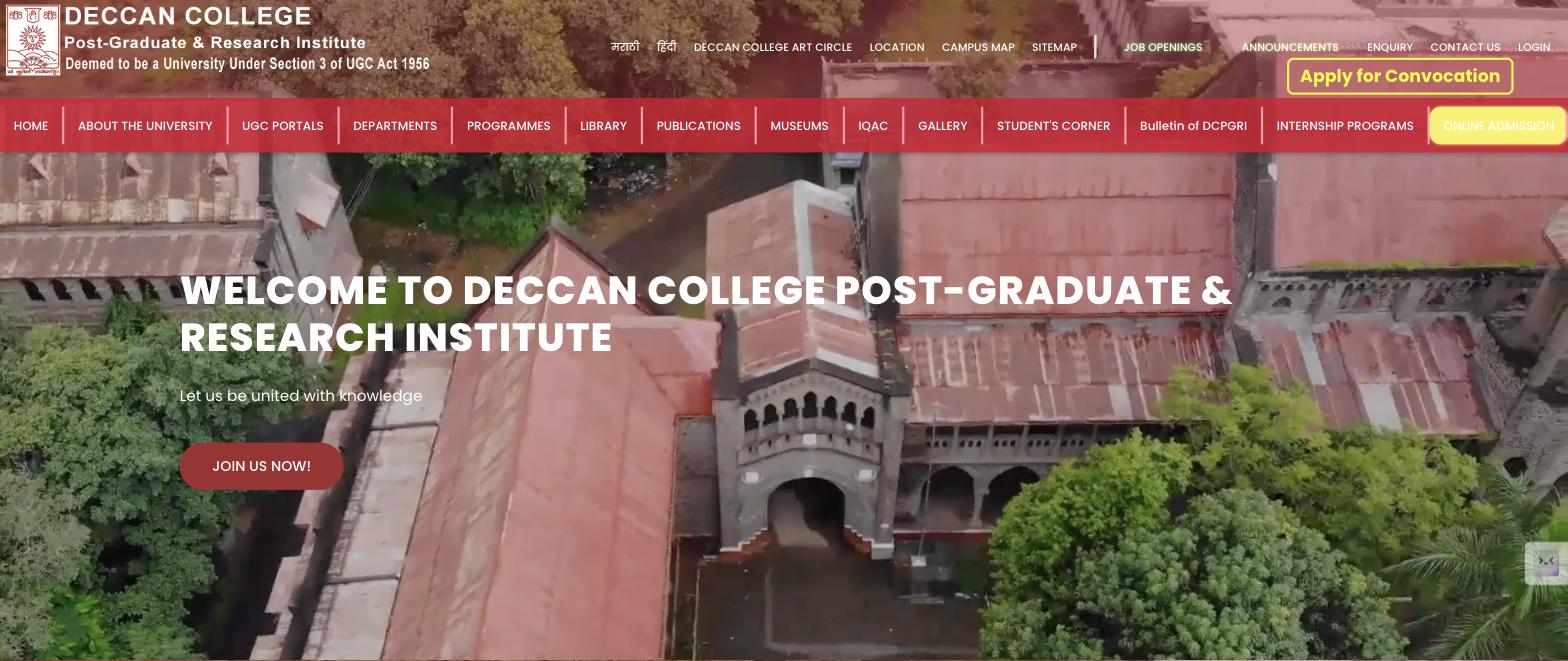
Deccan College began life as the Hindoo College, also called the Poona Sanskrit College, and its first principal was Major Thomas Candy. English and modern subjects were added in 1837, and later principals included Sir Edwin Arnold, author of The Light of Asia. The Gothic main building near Yerawada, still in use, is one of Pune's landmarks.
Since its revival in 1939 it has been a postgraduate research institute in three fields: archaeology, linguistics, and Sanskrit and lexicography. In archaeology it became one of India's leading schools through scholars such as H. D. Sankalia. In Sanskrit it is best known for the Encyclopaedic Dictionary of Sanskrit on Historical Principles, a project begun in 1948 that traces the history of every Sanskrit word through its uses across the literature — one of the largest dictionary projects in the world.
Frequently asked questions
Is Deccan College a university?
Yes. It was declared a Deemed University in 1990 and has functioned as one since 1994–95.
What can I study at Deccan College?
M.A. programmes in Sanskrit and Lexicography, in Ancient Indian History, Culture and Archaeology, and in Linguistics, along with Ph.D. and certificate courses.
Which famous people studied there?
Its students included the Sanskritist R. G. Bhandarkar and Lokmanya Bal Gangadhar Tilak.
What is the Encyclopaedic Dictionary of Sanskrit?
A long-running Deccan College project, begun in 1948, to record the meanings of Sanskrit words on historical principles, with citations from texts across the centuries.
Spotted a mistake?
If you find any grammatical, Hindi, English, mantra-text or other mistake on this page, tell us — we will correct it within 24 hours.