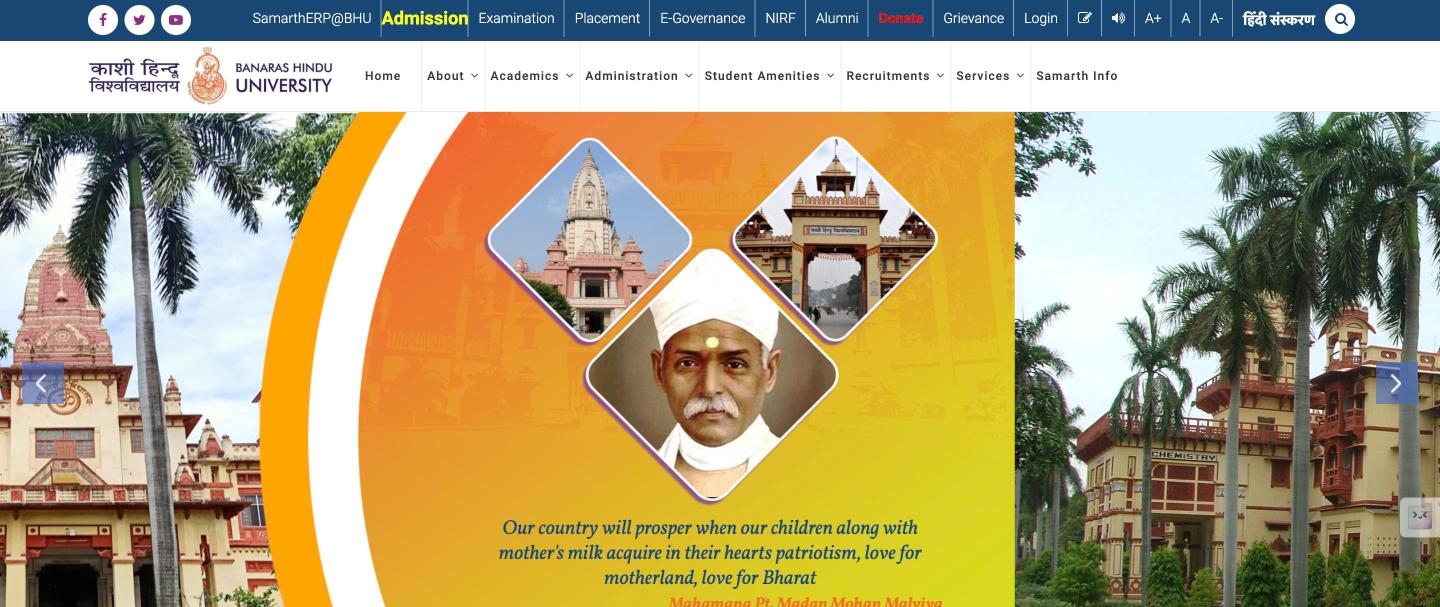
Faculty of Sanskrit Vidya Dharm Vigyan, Banaras Hindu University
संस्कृत विद्या धर्म विज्ञान संकाय, काशी हिन्दू विश्वविद्यालय
- Established
- 1918
- Type
- University
- Location
- Varanasi, Uttar Pradesh
About
The traditional-shastra faculty of Banaras Hindu University, established in 1918 — two years after Pt. Madan Mohan Malaviya founded the university — and first known as the Faculty of Prachya Vidya. With eight departments, it teaches Shastri and Acharya across Veda, Vyakarana, Sahitya, Jyotish, Darshan, Dharmashastra and more, along with Vidyavaridhi (Ph.D.), and has published the Vishwapanchang since 1926.
Courses & areas of study
- Shastri — 4 years under the NEP curriculum, admission through CUET-UG
- Shastri subjects: Shukla Yajurveda, Krishna Yajurveda, Vyakaran, Sahitya, Jyotish Ganit, Jyotish Falit, Sankhyayoga, Nyay-Vaisheshika, Vedant, Puranetihas, Dharmashastra, Mimansa, Dharmagam, Jain Darshan, Bauddha Darshan
- Acharya (postgraduate)
- Vidyavaridhi (Ph.D.) in Sanskrit, theology and traditional subjects
- Diploma and certificate courses
History
Founded in 1918
Banaras Hindu University was founded in 1916 by Pandit Madan Mohan Malaviya. The Faculty of Sanskrit Vidya Dharm Vigyan followed in 1918, first as the Faculty of Prachya Vidya, with a double aim: to preserve and advance the study of the ancient shastras, the Sanskrit language and its literature, and to open a meaningful dialogue between Eastern and Western traditions.
What it stands for
In BHU's own words, one of the faculty's aims is to dispel unfounded misconceptions about Hindu religion, spirituality, astrology and Tantra, and to restore basic moral and religious values. Classical texts are still taught in keeping with India's oral and written traditions.
Scholarship
The faculty publishes an annual research journal, Sanskritvidya, and has published the Vishwapanchang every year since 1926. Today it has eight departments and one centre, teaching 23 subjects.
Traditional shastras inside a modern university
What makes this faculty unusual is its setting. It is a part of Banaras Hindu University — one of India's largest residential universities, with faculties of medicine, engineering and science — yet it teaches the classical shastras in the traditional way, in Kashi, the city that has been the capital of Sanskrit learning for centuries. Students can choose from an exceptionally wide range of Shastri subjects: both Shukla and Krishna Yajurveda, Vyakarana, Sahitya, mathematical and predictive Jyotish, Sankhya-Yoga, Nyaya-Vaisheshika, Vedanta, Puranetihasa, Dharmashastra, Mimamsa, Dharmagama, and even Jain and Bauddha Darshan.
The faculty is also known to the public for the Vishwapanchang, the almanac it has calculated and published every year since 1926, which many households in North India use to fix festival dates and muhurtas.
Frequently asked questions
How do I get admission to the Shastri course at BHU?
Admission to the four-year Shastri programme under the NEP curriculum is through CUET-UG.
What is the Vishwapanchang?
The annual almanac published by the faculty since 1926, used widely for festival dates and auspicious timings.
Can I study Jain or Buddhist philosophy here?
Yes. Jain Darshan and Bauddha Darshan are among the Shastri subjects.
When was the faculty founded?
In 1918, two years after BHU itself, originally as the Faculty of Prachya Vidya.
Spotted a mistake?
If you find any grammatical, Hindi, English, mantra-text or other mistake on this page, tell us — we will correct it within 24 hours.