
Bharatiya Vidya Bhavan, Mumbai
भारतीय विद्या भवन, मुंबई
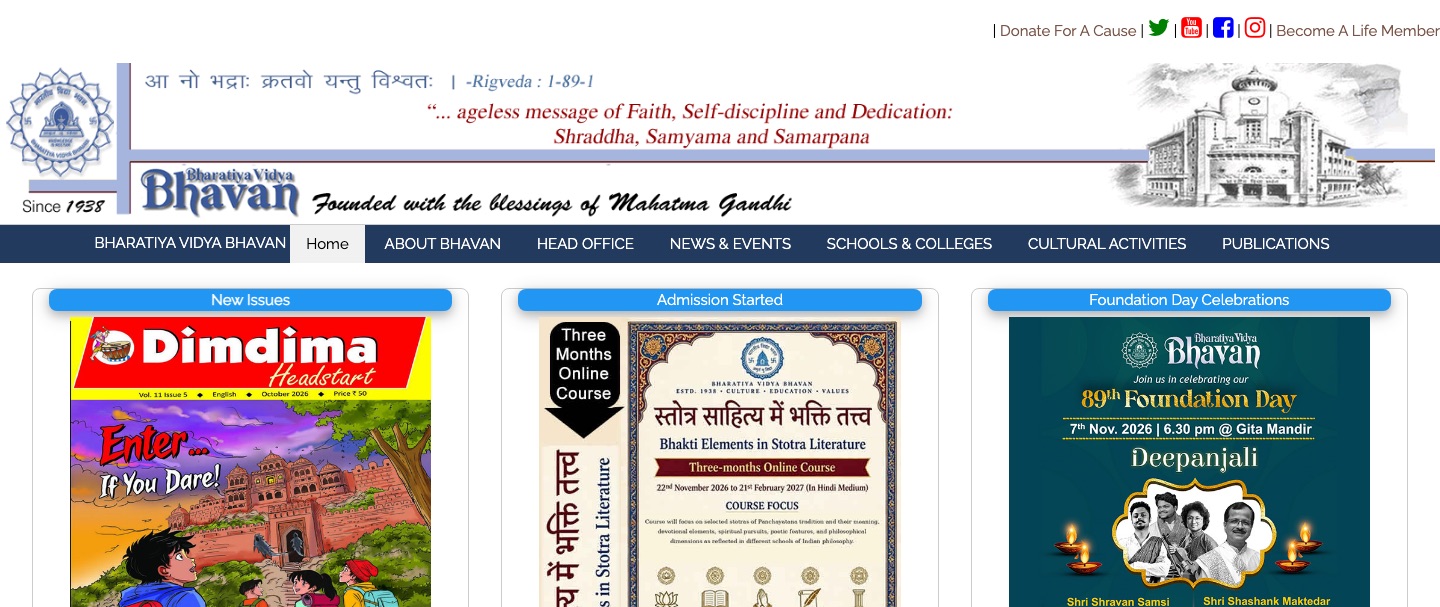
- Established
- 7 November 1938
- Type
- Institute
- Location
- Mumbai, Maharashtra
About
Founded by Kulapati K. M. Munshi on 7 November 1938 to preserve Indian culture and promote Sanskrit. From its Chowpatty head office it conducts the Saral Sanskrit examinations (five graded levels, since 1956) and the Shastriya Sanskrit examinations (since 1945), runs online courses on Sanskrit texts, and maintains libraries for Indology, Sanskrit and manuscripts.
Courses & areas of study
- Saral Sanskrit examinations: Balabodha, Prarambha, Pravesha, Parichaya, Kovida (February and September)
- Shastriya Sanskrit examinations (annually in June)
- Online courses on Sanskrit texts, in Hindi medium (e.g. Paniniya Shiksha; devotion in stotra literature)
- Libraries for Indology, Sanskrit and manuscripts
History
An "adventure in faith" (1938)
Kulapati Kanaiyalal Maneklal Munshi founded the Bhavan on Kartik Sud Purnima, Samvat 1995 — 7 November 1938 — for the preservation and propagation of Bharatiya Sanskriti and of Sanskrit. Its earliest departments were Sanskrit, Comparative Philology, the Prakrit languages, Gujarati, Hindi, Indian History and Bhagavat Dharma. In 1939 the Mungalal Goenka Institute for Higher Sanskrit Studies was established, and on 1 September 1939 the Mumbadevi Sanskrit Pathshala was opened; it became the Mumbadevi Sanskrit Mahavidyalaya in 1946–47. A Jyotish Shikshapith followed in 1940.
Gita Vidyalaya, examinations and the Chowpatty home
The Gita Vidyalaya was started in 1945, along with the Bhavan's own examinations in Sanskrit and the Gita. The central building at Chowpatty, completed in 1949, was opened on 8 August 1949 by C. Rajagopalachari, then Governor-General of India. The Bhavan has conducted the Saral Sanskrit examinations since 1956 — Balabodha, Prarambha, Pravesha, Parichaya and Kovida — at more than 200 centres in India and abroad, with over 22 lakh candidates so far, and the Shastriya Sanskrit examinations since 1945.
From one building to a national movement
K. M. Munshi founded the Bhavan with the support of Mahatma Gandhi, and it grew far beyond its Chowpatty head office. After Munshi's death in 1971 it expanded into a worldwide organisation, opening its first foreign centre in London in 1972; today it runs well over a hundred centres in India, several abroad, and a large network of schools known as Bhavan's Vidyalayas or Bharatiya Vidya Mandirs. Its publishing has been equally influential, above all the multi-volume History and Culture of the Indian People and the popular Bhavan's Book University series.
For Sanskrit learners, its most widely used offering is the graded Saral Sanskrit examinations — Balabodha, Prarambha, Pravesha, Parichaya and Kovida — which more than 22 lakh candidates have taken at centres in India and abroad since 1956. They let anyone, child or adult, learn Sanskrit step by step without enrolling in a degree.
Frequently asked questions
What are the Saral Sanskrit examinations?
Five graded Sanskrit exams — Balabodha, Prarambha, Pravesha, Parichaya and Kovida — held in February and September at centres in India and abroad.
Can adults take them?
Yes. They are open to learners of any age, and are a common way for adults to learn Sanskrit part-time.
Who founded Bharatiya Vidya Bhavan?
Kulapati K. M. Munshi, on 7 November 1938, with the support of Mahatma Gandhi.
Does it offer online courses?
Yes, online courses on Sanskrit texts in Hindi medium, such as on the Paniniya Shiksha and on devotion in stotra literature.
Spotted a mistake?
If you find any grammatical, Hindi, English, mantra-text or other mistake on this page, tell us — we will correct it within 24 hours.