Bhandarkar Oriental Research Institute (BORI), Pune
भाण्डारकर प्राच्यविद्या संशोधन संस्थान (BORI), पुणे
- Established
- 6 July 1917
- Type
- Institute
- Location
- Pune, Maharashtra
About
A research institute in Pune founded on 6 July 1917 in honour of Sir Ramakrishna Gopal Bhandarkar. It produced the Critical Edition of the Mahabharata, holds over 28,000 manuscripts and 1,25,000 books, and today runs the Prakrit Dictionary project, online BharatVidya courses on the Vedas, epics and darshanas, and a PG course in preventive conservation.
Courses & areas of study
- BharatVidya online courses (26 courses in 7 categories): Mahabharata, Vedas and Upanishads, Vedic suktas, Indian philosophy, Kashmir Shaivism (Spandakarika), Kautilya's Arthashastra and more
- Online Sanskrit learning in the traditional way
- PG Course in Preventive Conservation (with IGNCA, Ministry of Culture)
- Research fellowships and visiting scholar programmes (Infosys Foundation Academic Programme)
History
Founded in honour of R. G. Bhandarkar (1917)
The institute was founded on 6 July 1917 to commemorate the name and work of Ramakrishna Gopal Bhandarkar, whom it calls the foremost pioneer of scientific Orientology in India. The decision was taken at a meeting at Anandashrama, Pune. The Manuscript Collection of the Government of Bombay was transferred to the institute, which also began building its own collection, and it organised the first session of the Indian (later All India) Oriental Conference, presided over by Bhandarkar. Its journal, the Annals of the Bhandarkar Oriental Research Institute, followed.
The Critical Edition of the Mahabharata
Work on the Critical Edition of the Mahabharata was inaugurated by Bhandarkar himself. Edited by V. S. Sukthankar, S. K. Belvalkar, S. K. De and R. N. Dandekar, it consulted 1,259 manuscripts over about five decades, from April 1919 to September 1966. The completed edition — 18 parvans, more than 89,000 verses in the constituted text, 19 volumes — was released on 22 September 1966 by President Sarvepalli Radhakrishnan. A critical edition of the Harivamsha and a Cultural Index of the Mahabharata followed. Since 1988 the institute has also been preparing a comprehensive dictionary of the Prakrit languages.
A manuscript library of world importance
BORI holds one of the largest collections of rare books and manuscripts in South Asia — over 1,25,000 books and nearly 30,000 manuscripts in Sanskrit, Prakrit and other languages. In 2007 its collection of Rigveda manuscripts was inscribed on UNESCO's Memory of the World Register, recognising it as documentary heritage of global significance. The institute also hosts a Manuscripts Resource and Conservation Centre of the National Mission for Manuscripts, and publishes its Annals four times a year.
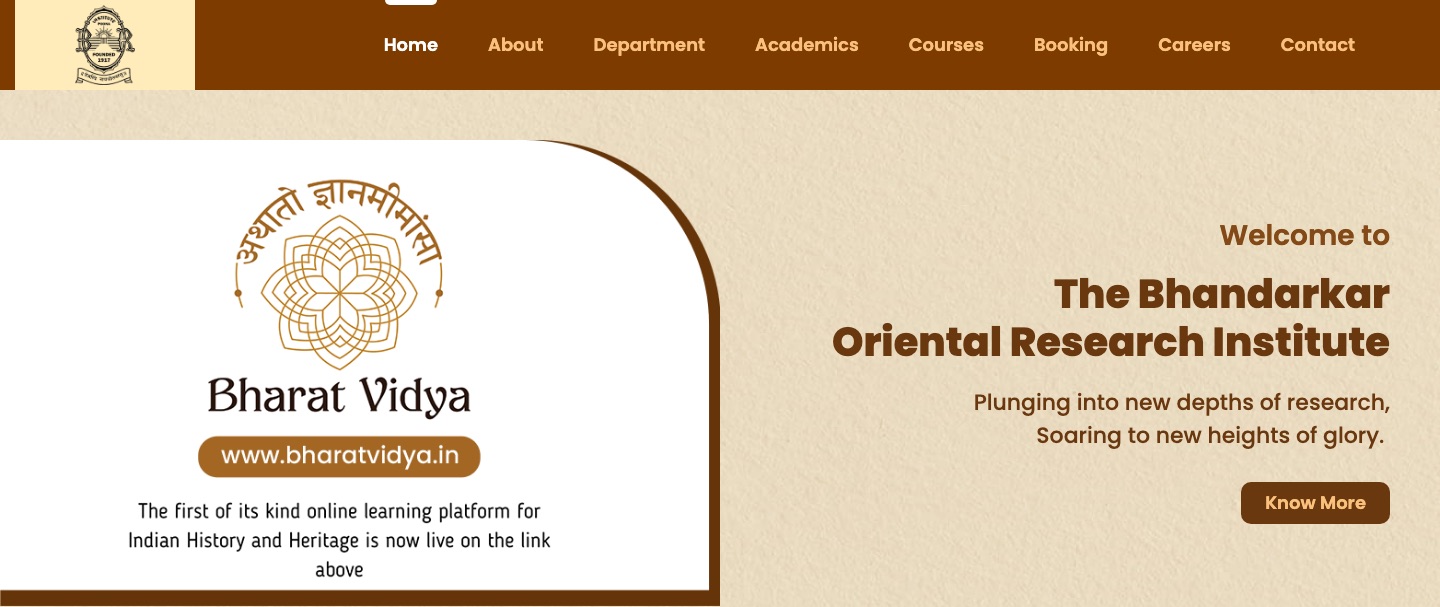
For the public, its most accessible offering today is BharatVidya, a set of online courses on the Mahabharata, the Vedas and Upanishads, Indian philosophy, Kashmir Shaivism, the Arthashastra and more, along with traditional-style Sanskrit lessons — a way to learn from the institute that produced the Critical Edition of the Mahabharata without travelling to Pune.
Frequently asked questions
What is the Critical Edition of the Mahabharata?
A scholarly edition prepared at BORI from 1919 to 1966 by comparing 1,259 manuscripts to reconstruct the oldest recoverable text; it runs to 19 volumes and 18 parvans.
Are BORI's Rigveda manuscripts recognised by UNESCO?
Yes. They were inscribed on the UNESCO Memory of the World Register in 2007.
Can I take a course at BORI online?
Yes. Its BharatVidya platform offers online courses on the Vedas, epics, darshanas and more, and online Sanskrit lessons.
Who is BORI named after?
Sir Ramakrishna Gopal Bhandarkar (1837–1925), a pioneer of modern Indological scholarship in India.
Spotted a mistake?
If you find any grammatical, Hindi, English, mantra-text or other mistake on this page, tell us — we will correct it within 24 hours.